A cross in a valley’s name. A saint remembered in a small settlement above the river. A field whose name says that a church once stood there, although almost nothing remains. In Imerkhevi, religious history is sometimes part of the directions people give one another.
Jvariskhevi and Adriatsminda are especially recognisable examples. But the record becomes richer when we leave the list of villages and look at the names of meadows, slopes, ruined buildings and summer pastures. Some preserve Christian vocabulary quite openly. Others combine Georgian word formation with a borrowed word for a church. Still others have been connected with pre-Christian worship, although those interpretations need a different degree of caution.
This article follows the historical Georgian names and locally recorded forms, rather than the later official replacement names. Its starting point is Imerkhevi, the Georgian-speaking valley within historical Shavsheti. Where comparisons come from the rest of Shavsheti or neighbouring Klarjeti, they are identified as such. The wider region helps us understand the pattern, but its names cannot all be placed inside Imerkhevi.
Jvariskhevi: the cross and the valley
Jvariskhevi — ჯვარისხევი brings together jvari, “cross,” and khevi, “valley” or “ravine.” The connecting -s- belongs to the possessive construction: the valley of the cross, or “Cross Valley.” The shorter form Jvarkhevi also appears in the historical-name literature.
This is a clear religious element, but it does not supply the whole history of the place. Did the name refer to a standing cross, a church, a shrine, or land associated with such a site? When was it first used? The name alone cannot choose between these possibilities. Its Christian vocabulary is considerably more secure than any particular story about its foundation.
There is a further complication familiar to anyone reading the older village lists. Marr records Jvariskhevi among the settlements grouped with Surevani. Later works arrange the same landscape differently, sometimes treating these places as distinct settlements and sometimes as neighbourhoods of a larger administrative village. The name of a valley, a stream and an inhabited place can overlap without the boundaries being identical.
The 2011 collective monograph Shavsheti places Jvariskhevi beside two smaller examples: Jvari, a meadow in Surevani, and Kinijvari, a meadow in Machkhateti. This takes us beyond one picturesque village name. Cross vocabulary had entered the vocabulary of land itself, including places described by their later agricultural use.
That last point is easy to miss. A meadow can retain the name of a former sacred landmark after its everyday function has changed. Conversely, the continued use of a cross-name does not mean that everyone using it still understands the place as a Christian shrine. Naming, worship and memory can follow different paths.
Adriatsminda: a saint’s name in everyday geography
The place often written Adriatsminda on this website appears in the sources as Andriatsminda — ანდრიაწმინდა, alongside forms such as Ardiatsminda. Nugzar Tsetskhladze’s toponymy study explicitly relates the locally recorded form to Andrias-tsminda. Its elements point to Andrew and tsminda, “holy” or “saint”: in ordinary English, a place associated with Saint Andrew.
The variations matter. An old name is not necessarily passed down as one unchanging spelling. It moves through local speech, the notebooks of travellers, Russian administrative documents, Turkish writing and modern Georgian scholarship. The underlying connection with Andrew should be explained through those recorded forms, rather than by treating the website’s English spelling as the original evidence.
Kazbegi already lists Andriatsminda among the settlements of upper Imerkhevi in his account of the 1874 journey. Marr’s 1904 diary locates it in the Chikhori landscape, and the 2019 historical-name study also places it among Chikhori’s neighbourhoods. It is therefore a documented historical name, not a religious interpretation recently attached to an anonymous ruin.
The name also opens a question that deserves a careful answer: does it demonstrate that the Apostle Andrew personally visited this settlement? It does not. A dedication to a saint, the circulation of stories about that saint and an apostle’s actual itinerary are different kinds of historical claim. The name is evidence for the local commemoration of Andrew; establishing an apostolic visit would require independent evidence.
One small detail makes the surrounding sacred geography more interesting. In the gazetteer appended to the 2015 expedition reports, the entry for Andriatsminda includes the microtoponym Mariatsminda — მარიაწმინდა. A name associated with Mary thus appears inside the recorded landscape of the Andrew-name settlement. The entry gives us the name, however, rather than a securely dated history of a Marian church. It should be read at that level.
Elia, Mary and the smaller names
The ending -tsminda is not confined to Andriatsminda. Tsetskhladze records Eliatsminda — ელიაწმინდა at former church sites in Ipkhreuli and Zakiyeti. The 2022 dialect monograph also records Eliatsminda in Chakvelta. These are separate attestations, not evidence that all the writers were describing one site.
Elia is the Georgian form of Elijah, the biblical prophet. Within this local pattern of saints’ names and church sites, Eliatsminda is reasonably understood as a religious name associated with Elijah. Yet the name does not tell us when a church was built, whether there was a formal dedication recorded in writing, or what ceremonies once took place there.
Mary-names belong to the wider regional pattern as well. Tsetskhladze’s inventory records Mariamtsminda in Chuarebi, outside the valley’s core examples. Marr’s diary and its modern editorial discussion preserve other shortened Marian forms from the broader Shavsheti–Klarjeti landscape. Such comparisons help explain how a long devotional name could become compressed in speech. They should not be merged into a single village or sanctuary.
Not every unfamiliar name ending in something like -tsminda can be assigned a saint with equal confidence. Nor does tsminda always have a religious meaning in every Georgian expression: it can also describe something clean, pure or fine. Context is what makes the saints’ names and the recorded church sites particularly persuasive.
Names that say a church used to be there
Some of the most revealing names contain no saint at all. Instead, they identify an earlier condition of the land. Georgian has productive ways of saying “the place where something once was.” In the toponymy studies, the prefix na-, combined with particular endings, creates names for former houses, mills, cultivated plots and religious sites.
Najvarevi — ნაჯვარევი, also recorded as Najuarevi, belongs to this group. The root is again jvari. Tsetskhladze and the Shavsheti monograph record the name in Zakiyeti and Manatba in entries associated with former church sites and cultivated land. Its sense is approximately “where the cross or shrine used to be.” Here the grammatical form itself carries an idea of the past.
Nasaq’drevi — ნასაყდრევი, recorded in Khevtsvrili, similarly points to a former church site through saq’dari, a word used for a church. A plot described in an inventory as cultivated land can therefore preserve the memory of an earlier religious use. Farming over or beside a site does not necessarily erase its name.
The 2011 monograph also lists Samatskhovre — სამაცხოვრე as a former church site in Manatba. Its wording suggests a connection with Matskhovari, “the Saviour.” That is a useful religious reading, but the brief inventory is not a foundation charter: it does not establish a building date, a founder or a complete dedication history.
These names are valuable because they direct attention to places a village list would omit. They can tell a researcher where to ask questions or look for material remains. They cannot, on their own, tell us who dismantled a building, why it disappeared, or when its religious use ended.
Nakilisari: a Georgian name built around a borrowed word
Another group makes the linguistic history especially visible: Nakilisari — ნაქილისარი and forms such as Nakilisvari — ნაქილისვარი. They combine Georgian formation for a former site with a version of Turkish kilise, “church.” The 2022 dialect study explains the form as the equivalent of Georgian naeklesiari, a former church site.
This is an important reminder about the phrase “old Georgian names.” A name can belong to the inherited Georgian-speaking landscape without every part of it having an exclusively Georgian origin. Speakers can borrow a word, adapt it to their own speech and use Georgian grammar to turn it into a place name. Linguistic contact becomes part of the record of Christian remains.
The expedition reports give us a particularly instructive example in Ipkhreuli. In 2015, investigators recorded a ruin overlooking the old bridge at a place residents called Nakilisari. Yet their architectural assessment was that a tower might have stood there. The report marks that identification as uncertain.
This does not make the local name worthless, and it does not prove the investigators wrong. It shows why the two records must be kept side by side. The name may preserve an older association, its reference may have shifted, or the surviving masonry may not be enough to identify the building. A religious name is an invitation to investigate a site, rather than permission to label every wall a church.
Libani: a church report, but an unresolved name
Libani — ლიბანი deserves a closer look precisely because it is less transparent. It is recorded in the Chikhori area, while the 2022 study says its fieldworkers recorded it as a neighbourhood of Agara. The 2019 historical-name publication gives Libnati, noting Tsetskhladze’s form Libani. These descriptions need to be preserved rather than silently made identical.
Marr’s diary contains a useful report: he was told of church ruins, called Nakilisvari, in Libani. He also warns against a cartographic confusion: the map’s Lionidze, he says, belongs near Sinkoti, two or three versts away. Even before trying to explain a name, we have to be sure that different sources mean the same place.
The 2022 Shavshian Dialect monograph discusses Libani directly. It considers the similar dialect word libani/lebani, used for a segment or part of certain fruits and nuts, but finds the connection with the settlement difficult to explain. It then tentatively suggests a relationship with Livani, comparing Livana, through an alternation of b and v. This is presented as a possibility, not a settled derivation.
What about “Leobani,” and the possibility of a saint’s name behind it? I have not found a securely documented derivation of this Imerkhevian name from that proposed form in the sources examined. It would be misleading to turn the suggestion into an established dedication. The documented point is narrower and still interesting: a place called Libani was associated, in a report made to Marr, with church ruins. That establishes a religious connection in the locality; it does not establish a religious origin for the word Libani.
Do older, pre-Christian names survive?
The possibility is not merely a modern guess. Roland Topchishvili and Inga Ghutidze’s 2019 historical-name study explicitly identifies names in the wider Shavsheti–Klarjeti region that it connects with worship before Christianity. Two of its examples are Mokvta/Mogvta — მოქვთა/მოგვთა and Bagini — ბაგინი.
Their discussion links Mogvta, a village of Shavsheti, with mogvi, “magus,” and interprets it as a settlement of magi associated with fire worship. This is a published historical etymology, not a reconstruction invented for this article. It is also an example from the wider Shavsheti setting, rather than a securely identified pagan sanctuary in the Imerkhevi valley.
The same authors connect Bagini with a word for a pagan place of sacrifice. The settlement appears in their wider regional list, alongside places in the lower Chorokhi area. It therefore offers a comparison for the history of religious naming, not another name that can simply be added to Imerkhevi’s own village list.
Both interpretations deserve attention, but their evidential limits matter. The meaning proposed for a name is not equivalent to excavated evidence for a particular ritual. A possible connection with magi does not tell us which community used a site, when it did so, or exactly what people practised. Nor should all pre-Christian traditions be collapsed into one religion called “paganism.” The linguistic argument and the archaeological argument still have to meet.
The Shavsheti monograph also discusses customs that its authors interpret as preserving pre-Christian elements, including beliefs about water and fertility. Those traditions broaden the religious history, but they do not automatically explain the etymology of a nearby lake, mountain or village. A water ritual at a named lake and a lake name derived from a deity are different claims. The sources examined do not justify filling Imerkhevi’s map with confidently identified ancient gods.
Islam also entered the named landscape
Christian vocabulary is prominent among the inherited names discussed here, but it is not the only religious vocabulary recorded locally. Tsetskhladze describes Jame-mahale, “mosque neighbourhood,” as a widespread way of identifying the part of a village where the mosque stood. Elsewhere in the regional material, names derive from religious titles or households associated with a hodja, a mullah or a pilgrim.
These examples require a distinction. They are not offered here as medieval Georgian village names, nor as later official replacements for such names. They belong to another scale of everyday geography: neighbourhoods and households described through the institutions and people of Muslim community life. Turkish words and Georgian adaptations can coexist in that local repertoire.
Marr’s account of Tetraketi adds another connection between names and religious practice. Muslim villagers described journeys to a ziaret, a sacred place visited in pilgrimage, and the preparation of candles. In his account, earlier Christian sites were still destinations within the lived religious landscape of Muslim residents. Ziaret is first of all a term for a sacred destination or visit in this discussion; it should not be treated as proof that every site with that designation had the same origin.
A Christian place name surviving among Muslim speakers is therefore not a contradiction. People may retain a name because it identifies their fields or their neighbours’ homes, because it belongs to family memory, or because a place continues to be regarded as sacred in a changed setting. None of those possibilities allows us to decide a speaker’s personal beliefs from the place name they use.
A short guide to the names
| Name | Religious connection | What the evidence supports |
|---|---|---|
| Jvariskhevi ჯვარისხევი | Cross + valley or ravine | A clear Christian element; the precise original landmark remains uncertain. |
| Andriatsminda / Ardiatsminda ანდრიაწმინდა / არდიაწმინდა | Andrew + holy/saint | A documented saint-name connection; it does not establish an apostolic visit. |
| Eliatsminda ელიაწმინდა | Elia (Elijah) + holy/saint | Recorded at several localities, including former church sites. |
| Mariatsminda მარიაწმინდა | Mary + holy/saint | Listed within Andriatsminda’s local names in the expedition gazetteer. |
| Najvarevi ნაჯვარევი | A former cross/shrine site | Recorded in Zakiyeti and Manatba; its grammar points to an earlier condition. |
| Nakilisari / Nakilisvari ნაქილისარი / ნაქილისვარი | Former church site; Georgian formation with borrowed kilise | A useful site-name whose architectural identification still requires checking. |
| Libani ლიბანი | Etymology unresolved | Marr records a report of church ruins; a religious origin for the village name is unproved. |
| Mogvta and Bagini მოგვთა / ბაგინი | Published proposed pre-Christian connections | Regional comparisons beyond Imerkhevi proper, with interpretations requiring further corroboration. |
What the names can preserve
Read together, the names preserve more than one sort of religious history. Jvariskhevi carries a cross into the name of a valley. Andriatsminda preserves a saint in the name of a settlement. Najvarevi and Nasaq’drevi name an absence: something once stood or happened there. Nakilisari records that memory through the meeting of two languages. Libani reminds us that a locality can have a church history even when the origin of its own name remains open.
They also preserve different moments. The day a name first arose, the day a traveller wrote it down, the period when a church fell out of use and the present use of the name need not coincide. Kazbegi’s record of Andriatsminda establishes that he knew the name in the nineteenth century; it does not date its creation. A 2015 record of masonry describes the site in 2015; it is not an account of its condition today.
For future fieldwork, the smaller names may be as valuable as the famous ones. A careful recording would ask how residents pronounce the name, where exactly its boundaries lie, whether the same word names a field and a ruin, and who remembers another form. Older maps, family accounts and the remains on the ground can then be compared without requiring them to agree in advance.
The religious history in Imerkhevi’s place names is strongest where those different kinds of evidence can be brought together. It remains worth preserving where the answer is incomplete. A name does not have to yield a dramatic origin story to hold a community’s history.
Related reading: What do sources say about Imerkhevians converting to Islam?
Sources & image credit
Nugzar Tsetskhladze, Shavsheti–Imerkhevi Toponymy (2000). Read the source. PDF pp. 47, 69–70, 73, 84–85: Jvari, former-site formations, Andriatsminda, Eliatsminda and name elements. PDF p. 128 (printed p. 130): religious titles in neighbourhood names; PDF p. 134 (printed p. 136): mosque-neighbourhood naming. The systematic inventories and notes also locate Libani in the Chikhori group. PDF positions are supplied where the scan’s pagination differs from the printed numbering.
Mamia Paghava and co-authors, Shavsheti (Tbilisi, 2011). Read the source. Printed pp. 311–313 and 317–318 (PDF pp. 312–314 and 318–319): Samatskhovre, Najvarevi, Nasaq’drevi, saint-name formations, Jvari, Jvariskhevi and Kinijvari. The ethnographic sections provide context on pilgrimage and the authors’ interpretations of older ritual elements; these are not treated as proof of individual place-name etymologies.
Mamia Paghava, Meri Tsintsadze and Maia Baramidze, Shavshian Dialect (2022). Read the source. Printed/PDF p. 190: Libani, the map-name confusion, the comparison with libani/lebani and the tentative Livani/Livana connection. P. 250: Nakilisvari as the equivalent of naeklesiari. Pp. 261–262: Eliatsminda and Andriatsminda. This article preserves the tentative status of the Libani proposal rather than presenting it as a solution.
Niko Marr, Shavsheti–Klarjeti Travel Diaries, Georgian edition (Batumi, 2015), recording the expedition of 1904. Read the source. Printed p. 157 (PDF p. 80): settlements grouped with Surevani. Printed pp. 223–225 (PDF pp. 113–114): Andriatsminda, the report of church ruins at Libani, Lionidze and the Tetraketi pilgrimage account. The Libani ruins are reported to Marr, not presented here as a building independently inspected and dated by him. Access is through the Georgian edition, not an independently collated reading of the Russian original.
Roland Topchishvili and Inga Ghutidze, Toponyms of Shavsheti and Klarjeti in the Russian Documents of XIX Century and of the Beginning of XX Century (Tbilisi, 2019). Read the source. Georgian section pp. 8–9: Christian name elements and the authors’ proposed pre-Christian interpretations of Mogvta and Bagini. P. 16: Chikhori, Andriatsminda and Libnati/Libani; p. 18: Bagini in the wider regional list. These regional comparisons have not been represented as sites inside Imerkhevi proper.
Tao-Klarjeti: Materials of the 2015 Expeditions (published 2016; the expedition volume in this archive). Read the source. P. 62: Ipkhreuli’s Nakilisari, with the investigators’ tentative tower identification. P. 181: Andriatsminda and its listed microtoponyms, including Mariatsminda. P. 194: Jvarkhevi/Jvariskhevi in the gazetteer. These are records from the expedition and publication period, not a new survey of current conditions.
Giorgi Kazbegi, Three Months in Turkish Georgia, Georgian edition (1995), account of the journey of 1874. Read the source. Printed p. 87 (PDF p. 85): Andriatsminda in the list of upper-Imerkhevi settlements. Used here as a dated attestation of the name, rather than an etymological explanation.
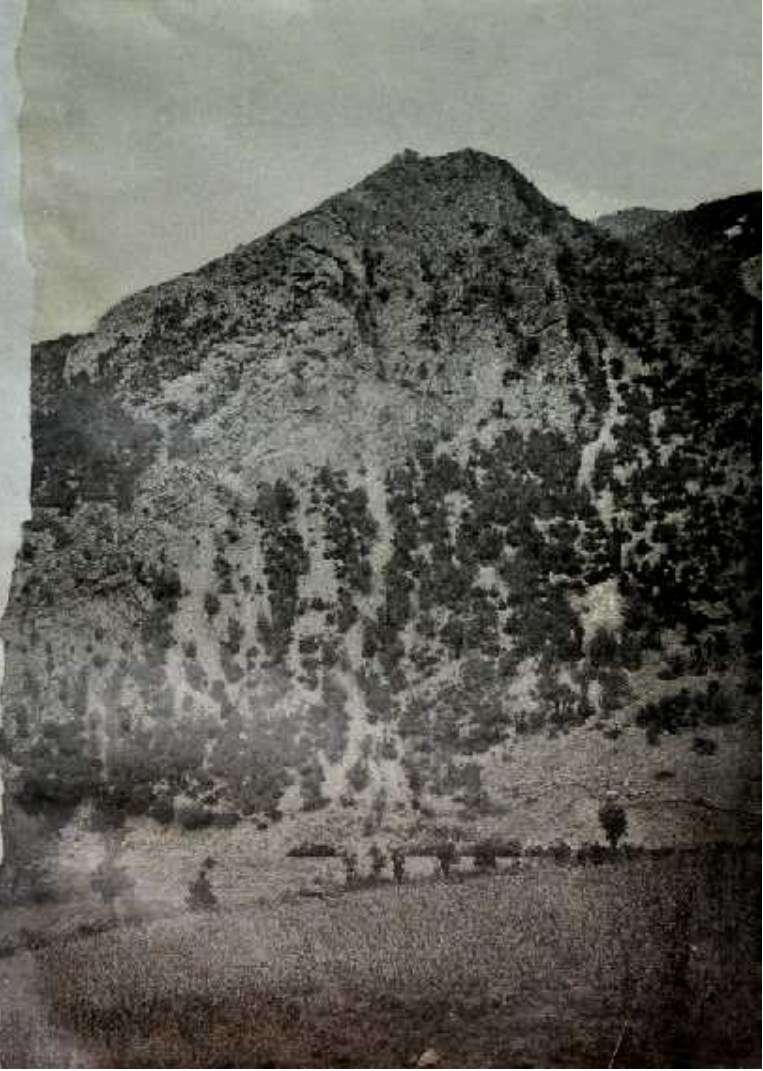
Image credit. Surevani church: photograph from Marr’s 1904 expedition, reproduced in the 2015 Georgian diary edition, printed p. 435, fig. 9 (PDF p. 219). It illustrates the local Christian built landscape; it does not identify the original object behind every cross-name.
Reading note. English explanations and transliterations are editorial. Local variants are retained where relevant. A transparent word element, a scholar’s etymological proposal, an informant’s recollection and an architectural identification are treated as different kinds of evidence. “Pre-Christian” does not imply that the date or precise religious affiliation of a named site has been established. Other material screened includes Paghava’s 2011 fieldwork notes; it has not been used to manufacture a religious explanation for Libani or “Leobani.”