Culture & everyday life
Explore the homes, food, seasonal work, stories and shared customs of Imerkhevi, through published fieldwork and photographs.

In Imerkhevi, culture can be read in the route to a summer pasture, the arrangement of a wooden house, a bowl of food offered to a visitor, and a story told in local Georgian. These practices connect the valley’s landscape with the skills and memories of its communities.
This account draws on fieldwork publications about Imerkhevi and the wider Shavsheti/Şavşat region. Village examples are identified where the sources allow; descriptions recorded in 2011, 2016 or 2018 should not be taken as a claim that every family follows the same customs today.
A year between village and yayla
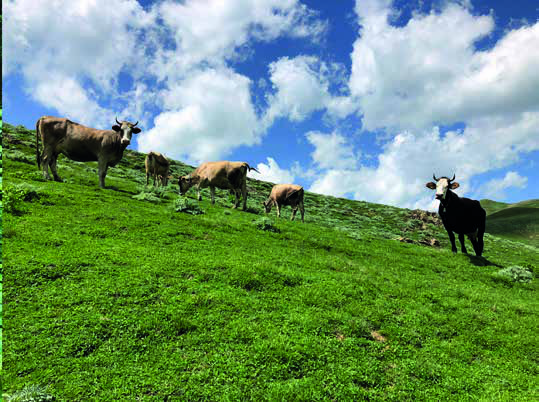
The valley’s settlements form a seasonal network. The village is the main home; mezra or kışla settlements serve as intermediate stopping places; and the yayla is the highland summer settlement. Moving between them links grazing, milking, haymaking, cultivation and visiting relatives. The summer house is therefore part of a working household spread across different elevations.
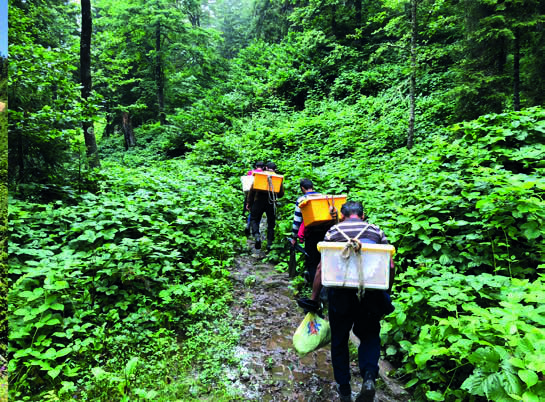
Summer concentrates work for the coming winter. Pastures support cattle, gardens and fields supply food, and fodder must be gathered and stored. Asrav’s 2018 fieldwork also describes beehives being moved towards highland flowering plants. Winter changes the pace: caring for animals continues, while evenings allow visits and conversation. In her interviews, snow also had a practical role, allowing timber to be brought from the forest on ox-drawn sledges.
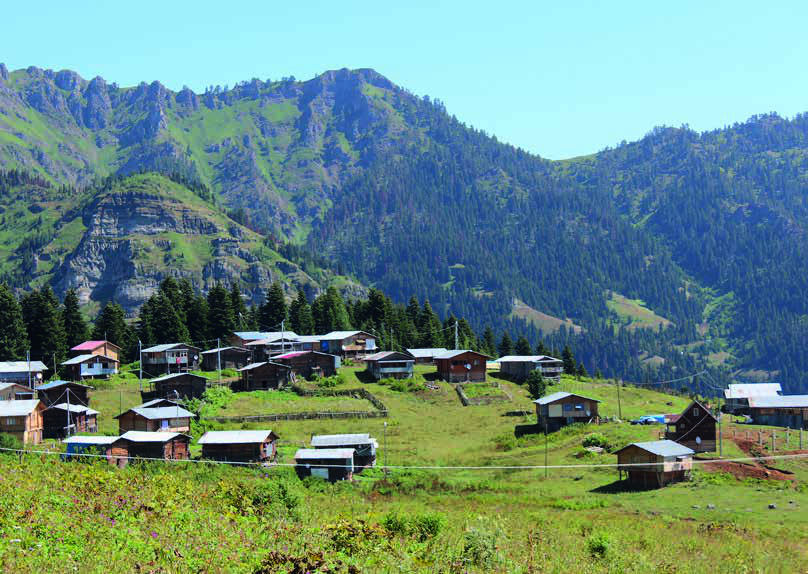
Houses built around household life
Timber, stone, slope and climate shape the traditional house. Doğanay and Orhan’s study of Şavşat describes stone foundations and extensive timber construction, with two or three storeys often combining an animal shelter below and living rooms above. Their examples include a house plan from Ube/Oba. Balconies, storage rooms, hay barns and mills belong to the same domestic economy. Asrav records balconies used for drying food and separate spaces for guests.
The ethnography in Shavsheti makes these arrangements tangible. A house in Svirevani/Surevani is described through its family room, pantry, summer cooking space, balconies and hay store. In Badzgireti, the researchers recorded a Tetrienti family house remembered as having accommodated three brothers together. From Ube they describe hollowed wooden logs joined to carry water to a home. These details show how building knowledge, family arrangements and daily work fitted together.
The historical house photograph above offers an earlier view of this architectural world. It was published in connection with Marr’s 1911 work; the photographer and precise capture date remain unverified.
The kitchen: grain, milk, beans and fruit
The kitchen described in Shavsheti rests on the combination of cultivation and livestock keeping. Maize and wheat flour, dairy products, beans, greens and fruit recur alongside meat dishes and festive sweets. Connections with neighbouring Adjara are particularly prominent. Local names and preparation methods vary, so the following are documented examples rather than a fixed menu for the whole valley.
| Name | What the source describes |
|---|---|
| Mchadi & chimuri | Maize bread; chimuri is hot maize bread crumbled into browned butter. The book specifically connects a Badzgireti family nickname with fondness for this dish. |
| Bishi, gevregi, sinori, erishta | Names for dough, bread and flour-based preparations. Gevregi is described as bread or maize bread kneaded with cream and baked in clay pans; erishta also appears in an account of hospitality in Badzgireti. |
| Matsoni, do/ayran, dontbari | Fermented milk, a drink associated with churning, and strained fermented milk. Dontbari could be brought down from the highlands and diluted with water. |
| Gorjolo, pshvnila, chichikoni | Recorded cheese names, including a braided cheese. The account also describes wooden vessels and other containers for keeping dairy products. |
| Lobioshorva & greens | Bean dishes made from dried beans or fresh green beans; greens, nettles and other edible plants also appear in soups and preserved foods. |
| Bekmezi & fruit preparations | Fruit juice boiled down to a concentrate, with mulberry, grape, pear, apple and bilberry named. Cooked pears and fruit drinks also feature. |
Preserving food is as significant as preparing a meal. Salting butter, storing cheese, drying produce and concentrating fruit link the busy summer to winter supplies. A detailed house description even locates the wooden pressing equipment and boiling place for fruit syrup within the household yard. At weddings, the book records richer tables including pilaf, stuffed peppers, börek, baklava and rose-petal preserve.
Shared work, skilled hands
Asrav describes imece, collective work through which neighbours help with demanding tasks: building, moving timber, working fields, preparing winter food and processing wool or grain. Her account records a division of tasks between men and women; this is a description of the fieldwork setting, rather than a rule for all households. The ability to call on others connects practical work with social relationships.
Woodworking supplied buildings, furniture and everyday implements; basket-making and weaving also met household needs. Beekeeping combines knowledge of woodland, flowering seasons, hive-making and the movement of swarms. The 2011 ethnography distinguishes hollow-log hives from other hive forms and preserves local names for their parts and use. These objects carry a vocabulary of materials and techniques as well as a practical function.
Making room for a guest
Hospitality is visible both in houses and at the table. Shavsheti describes guest rooms, bedding and utensils kept for visitors. Its researchers recall being welcomed in Badzgireti with strained fermented milk diluted in water, honey, erishta, bishi and tea. With the woman of the household away in the highlands, a neighbour helped the host prepare the meal. This small episode connects seasonal movement, neighbourly help and the welcome offered to a stranger.
The same chapter records polite invitations to eat in Ube and Svirevani, and ways of signalling that enough tea has been served, such as placing a spoon over the glass. Such details give hospitality its local texture: it involves words, gestures, objects and the work of preparing a place for someone.


Gatherings, celebrations and play
The highland summer also has a social calendar. Marioba/Mariyoba and other yayla festivals bring people together, including relatives returning from elsewhere. Shavsheti describes Marioba around the middle of the summer-pasture season and records the authors’ participation on the Ustamisi yaylas. Visits, shared food, markets and entertainment accompany the gathering. Its historical interpretation of the festival should be distinguished from the activities the researchers actually observed.
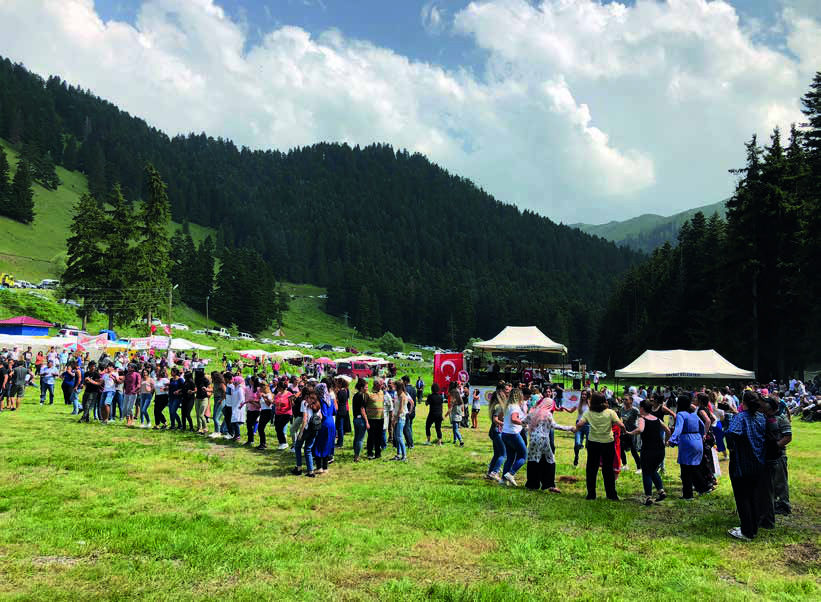
Weddings bring another set of exchanges and performances. The 2011 study describes children playfully blocking the wedding party’s route, gifts and sweets, and verses exchanged between the two sides. It also records differences between valleys in wedding food and ceremony. These accounts are valuable precisely because they preserve variation rather than a single universal wedding script.
Play has its own history. The book describes lefiki, a team contest involving throwing stones at arranged stone targets, and bila jokhi, a game with a short wooden piece and a longer striking stick. These accounts preserve terminology, rules and memories of recreation alongside the better-known ceremonial traditions.
Music and dance accompany gatherings, but recordings, lyrics and musical traditions have their own home in the archive. Explore the songs collection →
Literature carried by the voice
The region’s literary heritage includes a rich oral literature. Tina Shioshvili’s Shavshian Folklore brings together proverbs, riddles, blessings, incantations, legends, historical narratives, jokes and children’s material, alongside poetry. These forms belong to different occasions: a proverb offers a judgement, a riddle invites a response, a blessing expresses goodwill, and a joke can turn criticism into shared laughter.
The collection discusses stories about Queen Tamar, supernatural beings and remembered places, as well as humorous tales associated with Badzgireti and figures such as Nasreddin. Legends reveal how people give meaning to a landscape; they should be read as oral traditions rather than as direct proof of historical events. Local versions and the circumstances of telling are part of their value.
Religious verse also joins language and literary practice. Shioshvili discusses versions of Gurji Vaizi, a Georgian-language didactic religious poem used in Georgian-speaking communities. The broader picture is one of Georgian expression living alongside Islamic religious life and contact with Turkish. The words of a narrator, the village and the recording date matter as much as a genre label.
Faith, mourning and mutual care
Religious life and community obligations meet in rites of passage. Erdoğan Altınkaynak’s 2016 study, based on interviews in Meydancık and surrounding villages, documents Islamic funeral practices together with Georgian-language lament and condolence. One particularly concrete form of support is food: neighbours prepare meals for the bereaved household and help with its work, allowing the family to mourn.
The study records family burial places and remembrance through visits, prayers and the keeping of personal objects. Its material comes from named interviewees and a particular research visit; practices can differ between families and change over time. It shows that culture is also expressed through care at difficult moments, not only through celebrations.
A living, changing heritage
Migration, changing work, new building materials and movement between village and city have reshaped the settings in which knowledge is passed on. Asrav’s study makes a useful connection: protecting a rural landscape also means paying attention to the activities and relationships that sustain it. A house, a pasture, a recipe and a story are linked through the people who use and remember them.
This archive brings published documentation into conversation with local photographs, recordings and family memories. Its aim is to retain the detail of a place and a voice: who made an object, who told an account, where a practice was recorded, and how people describe its meaning today.
References use printed page numbers. Some works cover wider Shavsheti/Şavşat; the text identifies Imerkhevi examples where possible. Older observations are presented in their recorded context.
- Mamia Paghava et al., Shavsheti (2011). Ethnography by Tamaz Putkaradze: settlement and houses, pp. 102–106; kitchen, pp. 108–110; work and beekeeping, pp. 111–119; weddings, pp. 120–131; hospitality, pp. 132–133; festivals and games, pp. 137–142.
- Emine Çiğdem Asrav, “Protecting landscape as a network of relations: Challenges and perspectives in the case of Imerhev (Meydancik) Valley, Turkey” (2019), ri-vista 17(2), pp. 72–85. Fieldwork: summer 2018. Photographs from Figures 2–4, credited to the author, CC BY 4.0. Individual images extracted without alteration; layout may scale them.
- Tina Shioshvili, Historical South Georgian Folklore I: Shavshian Folklore (Batumi, 2016). Religious poetry, pp. 127–138; blessings, proverbs, riddles, legends, humour and children’s folklore, pp. 171–232; English summary, pp. 491–492.
- Hayati Doğanay & Fatih Orhan, “Şavşat’ta Geleneksel Köy Meskenleri ve Başlıca Sorunları” (2014), Atatürk Üniversitesi Sosyal Bilimler Enstitüsü Dergisi 18(1), pp. 273–297. Wider Şavşat context; construction and plans, pp. 277–290.
- Erdoğan Altınkaynak, “Meydancık Beldesi Gürcülerinde ‘Ölüm’” (2016), Karadeniz 31, pp. 21–26. Interviews recorded 28 May 2016 in Meydancık, Mısırlı and Balıklı.
Historical photographs are catalogued as public domain on Wikimedia Commons. Marr is the publication reference; the photographers are unverified. Dates in their captions are publication/catalogue dates, not independently verified capture dates.
A living archive. An ongoing conversation.
Documenting Imerkhevi through language, places, songs and shared memories.
Created by Ömer Faruk Bülbül · Sources & image credits