VILLAGES OF IMERKHEVI
Dasamobi / Dereiçi
დასამობი · Dasamop · Dereiçi · Şavşat, Artvin
Dasamobi connects a riverside settlement with the upper neighbourhoods of Davlati and Nioleti. Travel diaries and field recordings preserve its church ruins, pottery traditions, orchards, family names and Georgian voices.

Şavşat · Artvin · Turkey
Imerkhevi / Shavsheti
დასამობი · Dasamobi
Pottery and earthenware
Name, location and neighbourhoods
Dasamobi (დასამობი), also written Dasamop in Turkish local usage, is known by the Turkish name Dereiçi. It belongs to the Imerkhevi valley in Şavşat, Artvin. Paghava locates its lower settlement beside the road upstream from Shertuli, on both sides of the river, before reaching the Chakvelta fortress area. [1, pp. 159–160]
The name can refer both to this lower settlement and to a wider village grouping. In the 2009 account, Davlati and Nioleti are upper neighbourhoods, while Brili and the roadside Rabati/Pkhikiuri belong to the lower group. The 2026 family compilation uses the headings Dasamobi, Davlati, Brili, Rabat and Nioleti (Ardıçlı). Topchishvili and Ghutidze’s historical inventory also names Digieti and lists Rabati and Pkhikiuri separately. These are source-specific descriptions of settlement organisation, rather than interchangeable administrative lists. [1] [3, pp. 16, 71, 124] [4, p. 13]
Marr recorded a story that explained the name through da samobs, “the sister dances”: a brother follows his sister and finds her dancing on the mountain. Paghava instead proposes a connection with dasabami, “beginning”. The first is a local naming story and the second a scholarly proposal; neither should be presented as an established etymology. [1, pp. 159–160] [2, p. 157]
Marr’s visit and the old church
On 28 July 1904, Niko Marr set out for Dasamobi with his companions and a camera. His route passed Pkhikiuri and river crossings before he examined the ruined church. He describes stones partly covered by soil and vegetation, trees growing on the walls and an elongated rectangular plan with a rounded sanctuary. This is a description of what he encountered in 1904, not a survey of the remains today. [2, pp. 155–158]
A local resident, Mamud Ahmed-oğlu Jarbidze, told Marr that his grandfather had been a priest. Marr also reports that Armenian Christians and Georgian Muslims respected the ruins as a sacred place and visited at different times, including Easter. These testimonies preserve local religious memory alongside his architectural observations; the family account does not by itself date the church’s construction.
Marr counted three houses near the church and two higher on the hill. His five-house description concerns the small settlement he visited and cannot be treated as a census of all the neighbourhoods later grouped under Dereiçi. The historical toponym inventory likewise shows that Dasamobi’s relationship to Chihori and the surrounding settlements was recorded differently in different accounts. [2, p. 158] [3]
The church, sacred ground and springs
Marr measured the church’s interior as 5 sazhen and half an arshin long, and 11¼ arshin wide—roughly 11 × 8 metres using standard Russian units. He considered it larger than the usual local church and noted traces of a stone enclosure and substantial masonry adjoining the east wall. The south wall supported an old walnut tree. The ruins stood near the small stream he called Gigadzis-tsqali. [2, pp. 156–157]
The sanctity of the site survived the loss of the building. Marr recorded a warning story about a woman who cultivated a garden beside the south wall and died there; fear of punishment was said to discourage people from taking material from the ruins. This was a local belief he recorded, rather than his explanation of an actual death. He also mentions Gvala beside the river and two springs in the mountains to the north, visited locally for their supposed healing qualities. [2, pp. 157–158]
Pkhikiuri: community, crafts and the expedition photographs
Pkhikiuri deserves a place in the history of the wider Dasamobi grouping. In 1904 Marr described it as an Armenian village. Residents told him that their ancestors had come from Ani. A villager named Nersesiants pointed out the site of old baths near the Badzgireti river crossing and traces of a former bey’s residence at a place called Natsarevi. Another reported buildings and a stone winepress at Davlavuri. These notices distinguish places Marr examined from places identified through local testimony. [2, pp. 155–156]
His later account makes the village’s economy much clearer. Pkhikiuri’s Armenians practised tailoring, wool-working and shoemaking. They recalled a stronger trading economy before increasingly having to cultivate scarce land themselves. Marr recorded 24 houses, compared with a remembered former figure of about 70, and described a recent fire that had destroyed the village. These figures and experiences belong to Pkhikiuri; they should not be combined with his separate five-house count for Dasamobi. [2, pp. 164–165]
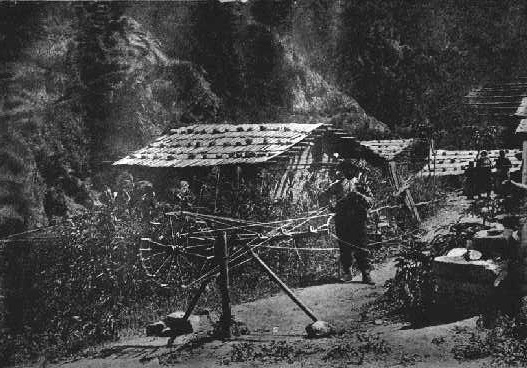
The craft photograph shows the preparation of thread rather than pottery. Marr describes men making goat-hair yarn on a frame, then weaving it into coarse cloth used for sacks, rugs and horse girths. His notes preserve Armenian and Turkish technical vocabulary for the apparatus. The image adds a different craft tradition to the pottery remembered in Davlati and Nioleti. [2, pp. 165–166; fig. 13, p. 439]
A landmark on the route: Bara fortress
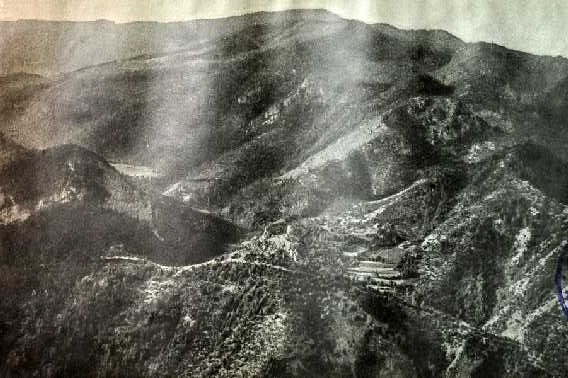
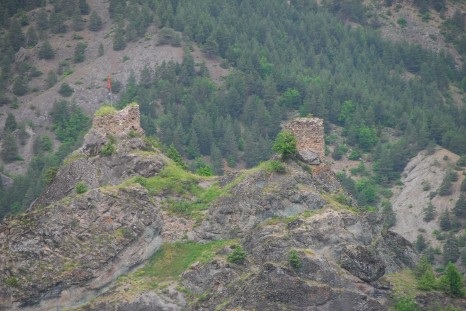
Marr passed the two-towered fortress on his journey to Dasamobi and described its striking rocky ridge. The 2015 monument expedition identifies it as Chakvelta fortress at Şenocak, also called Bara fortress, and records two masonry towers, remains of walls and a water reservoir. Its entry is dated 2 June 2015. The paired photographs connect the older travel account with a later survey of the same valley landmark. This is a neighbouring site on the route, separate from Dasamobi’s church. [2, pp. 155, 158] [6, p. 58]
Seasonal life, orchards and pottery
Paghava’s account of 4 August 2009 links the lower roadside settlement with winter movement from Davlati and Nioleti. Residents recalled bringing cattle down and transporting hay by cart to spend winter in Dasamobi. In summer, livestock could be taken to the Karchkhal highlands. The village’s history therefore includes movement between several homes and working landscapes. [1, pp. 159–162]
Davlati is described as lying below a high rock, with orchards containing numerous named varieties of pears, apples and plums, as well as grapes. The same conversations record changes in cultivation: residents remembered growing wheat and rye with ox-drawn ploughs, while some food was now bought rather than produced. The account captures a particular moment of change in 2009.
Pottery-making is one of the most distinctive occupations documented here. Residents remembered making and selling churi jars, ketsi baking pans, pots and dergi vessels, bringing clay from above and firing the products in a kiln. In neighbouring Nioleti, Enver described bringing clay from Davlati, making jars for preserved cabbage and other vessels, and the decline of the craft after the older makers died. These linked accounts give pottery a place within the everyday economy of the wider Dasamobi grouping. [1, pp. 161, 166–167]
ჭური
churi
An earthenware jar, remembered among the vessels made locally.
კეცი
ketsi
A clay baking pan, listed among the pottery products.
დერგი
dergi
An earthenware vessel named in the craft accounts.
Named fruit varieties
Paghava’s orchard list records more than a general abundance of fruit. The names preserve local agricultural knowledge: among the pears are Chikhorulai, Erboai, Khrashunai and Khechechurai; apples include Tsitelvashli, Bumbulai and Sinkotelai; plums include black and white varieties and Dodoflo. White grapes, black grapes and Adesai are also listed. These are names recorded in Davlati in 2009, not verified identifications of modern commercial cultivars. [1, p. 160]
Brili and Nioleti in the field accounts
On 6 August 2009 the researchers also visited Brili, a small hillside settlement with fruit trees, maize fields and its own summer pasture. They met Jemal and Mevlud Çelik, both fluent Georgian speakers. One lived in the village while the other spent summers there after working in Istanbul: a concrete example of the ties between the village and urban life. The account gives differing approximate household figures, so it is best read as a portrait of a small community rather than a precise population return. [1, pp. 177–178]
In Nioleti, former hodja Enver Seçgi recorded local names including Naseparti, Cherulti, Ch’ochnari, Gareqanebi and Tkhileb-ukanai. He explained Ch’ochnari as a wet place and Salebe as stony ground. Around coffee at Muzaffer Bülbül’s home, conversation moved between place-names, language and nearby villages. The field diary thus preserves both the working landscape and the sociable settings in which knowledge was passed on. [1, pp. 166–168]
Family names and neighbourhood records
Shavsheti records the names Jarbidze, Kherkhadze, Qurdzenadze, Khajishvili, Kurdo and Khajebi under Dasamobi. Its discussion also notes Jarbidze in Marr’s earlier documentation. These are published historical and ethnographic records, not a complete list of present-day residents. [5, p. 318]
Marr’s own 1904 list is worth retaining beside these later compilations. In addition to Jarbidze, he recorded Irigh-oğlu, Ts’makh-oğlu and Jir-oğlu (Georgian edition: ირიღ-ოღლი, წმახ-ოღლი, ჯირ-ოღლი) among Dasamobi’s five households. They are transcribed here as historical names; the sources reviewed do not establish how each relates to current Turkish surnames. [2, p. 158]
The table follows the Dasamobi entry in the eighth update of the 2026 village-and-lineage compilation. It retains the source’s associations without assuming that similar-looking names in different publications identify the same family. [4, p. 13]
| Neighbourhood | Published family entries |
|---|---|
| Dasamobi | Kurzenoğlu (Kurzenaşvili, Uzun, Gümüş); Algocebi (Çivadze, Oral); Carbidze (Yılmaz) |
| Davlati | Kurzenoğlu (Kurzenaşvili, Uzun) |
| Brili | Rendooğlu (Basiladze, Çelik); Tzarbaşvili–Tzarboğlu (Yalçın) |
| Rabat | Rendooğlu (Basiladze, Çelik); Kurdikidze; Turan |
| Nioleti (Ardıçlı) | Algocebi (Çivadze, Oral); Can; Bülbül |
Names and surname associations follow the 2026 compilation; the list is a source record, not an exhaustive register of current households.
Georgian speech and recorded voices
The 2009 researchers conversed in Georgian in Davlati, Rabati and Nioleti. Paghava particularly comments on the Georgian speech of his Davlati hosts and records both active use and concern about transmission to younger generations. His visit to Nioleti includes conversations with Muzaffer and Osman Bülbül and other villagers about local place-names, neighbouring settlements and language use. These are dated observations, not a measure of present-day fluency. [1, pp. 162, 166–168]
The published folklore also preserves contributions from named narrators: verses from Metin Ozanashvili and Ali Ildimiri (Qurdzenadze), recorded in Dasamobi in 1989; material from Muaser Uzun in Davlati on 4 August 2009; and Fikrie Oral in Nioleti on 5 August 2009. The recording notes connect texts to people, dates and particular neighbourhoods. [5, pp. 518, 524, 535, 546, 548, 566]
Among the local traditions is a Davlati account of Noah’s boat being fastened to Karchkhal. It is preserved as a legend associated with the mountain, rather than as a historical event. The same collection documents weather charms and wedding-related oral material from the wider Dasamobi community. [1, p. 161] [5, pp. 172, 198–199, 566]
Page numbers refer to the printed editions. Historical observations, local memories and the authors’ interpretations are distinguished in the text.
- Mamia Paghava, Shavshuri Chanawerebi / შავშური ჩანაწერები (Tbilisi, 2011), pp. 159–168, 177–178. 2009 field accounts of Dasamobi, Davlati, Rabati and Nioleti.
- Niko Marr, Shavsheti–Klarjeti Travel Diaries / შავშეთსა და კლარჯეთში მოგზაურობის დღიურები, Georgian edition (2015), pp. 155–158, 164–166; 438–439. Visit of 28 July 1904: church ruins, naming story and five-house settlement description.
- Roland Topchishvili & Inga Ghutidze, Toponyms of Shavsheti and Klarjeti in the Russian Documents of XIX Century and of the Beginning of XX Century (2019), pp. 124 (Georgian pp. 16; Turkish pp. 71; English pp. 124).
- Türkiye’deki Gürcü Köylerinin ve Gürcü Sülalelerinin En Kapsamlı Birleşik, Revize, Güncel Liste Çalışması, 8. Güncelleme (2026), pp. 13, “Dereiçi (Dasamobi) Köyü”.
- Mamia Paghava et al., Shavsheti / შავშეთი (2011), pp. 172, 198–199, 318, 518, 524, 535, 546, 548, 566.
- Şavşat community gallery — Dasamop / Dereiçi. Dasamobi community-gallery photograph. Contributor listed: Yücel Uzun; posted 25 July 2005. Capture date and exact viewpoint unverified.
- Teimuraz Khutsishvili et al., Reports of the 2015 Research Expeditions to Tao-Klarjeti Monuments (Tbilisi: Caucasus University, 2016), p. 58, Chakvelta fortress, 2 June 2015. Uncredited photographs are identified by the book as expedition photographs.
Book images are extracted from the supplied PDFs and reproduced with source, figure/page and expedition date. Marr’s two photographs are from the 1904 expedition, reproduced in the 2015 edition; the colour photograph comes from the 2015 expedition report. They retain the detail available in the source scans.
Photo credits
- Dasamobi community-gallery photograph — Dasamobi community-gallery photograph. Contributor listed: Yücel Uzun; posted 25 July 2005. Capture date and exact viewpoint unverified. / Imerkhevian house · Marr publication, 1911; photographer unverified
- Pkhikiuri craftsman preparing yarn on a frame — Pkhikiuri craftsman preparing yarn on a frame. Marr expedition, 1904; 2015 Georgian edition, fig. 13, p. 439.
- Bara fortress seen from the right bank of Imerkhevi — Bara fortress seen from the right bank of Imerkhevi. Marr expedition, 1904; 2015 Georgian edition, fig. 12, p. 438.
- Chakvelta / Bara fortress: two surviving towers — Chakvelta/Bara fortress in the 2015 expedition report: two surviving towers on a rocky crest. Khutsishvili et al. (2016), p. 58.
Dasamobi is documented in the Imerkhevi village collection alongside the Turkish name Dereiçi. Explore its photographs and developing archive.
Village histories, dated population records and community recordings will be added as the archive develops.
A living archive. An ongoing conversation.
Documenting Imerkhevi through language, places, songs and shared memories.
Created by Ömer Faruk Bülbül · Sources & image credits