Villages of Imerkhevi
Manatba
მანატბა · Yeşilce · Şavşat, Artvin
Manatba, associated with present-day Yeşilce, is documented through population records, family memories, songs and Georgian religious texts. Its recorded voices connect household work and migration with a local tradition of reading Georgian in Arabic script.
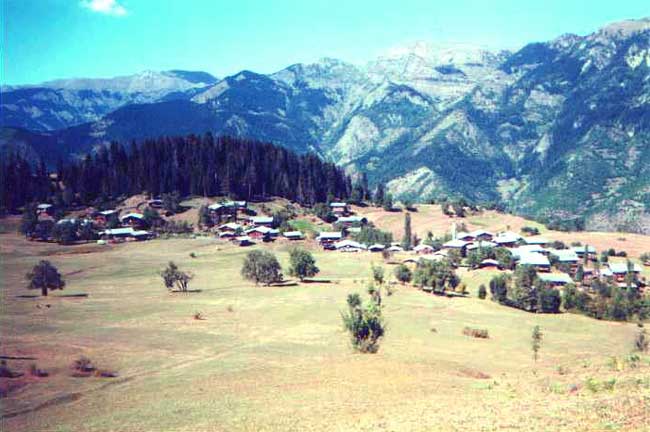
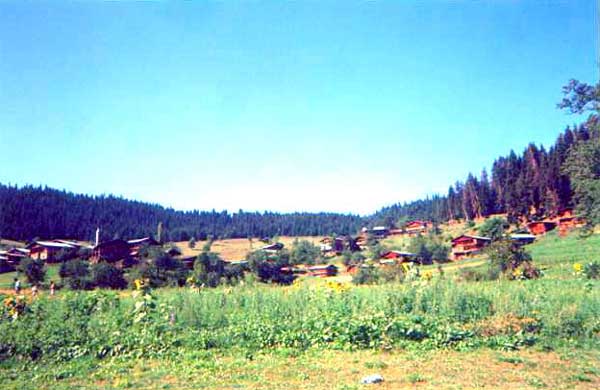
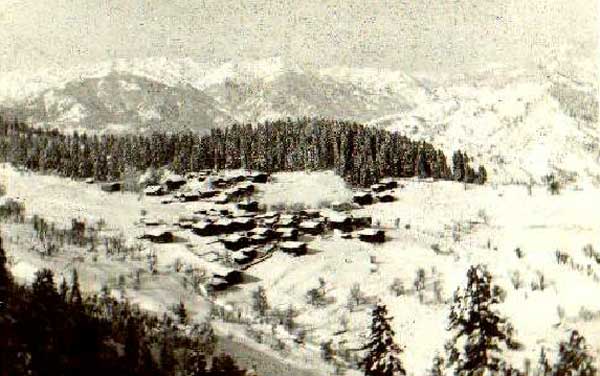
Manatba · მანატბა
Yeşilce
Okhet-Manatba · 150 residents
1 record
The village and its name
Manatba (მანატბა), also written Monatba in some sources, belongs to the Imerkhevi area of Şavşat, Artvin. The project’s village collection pairs it with the Turkish name Yeşilce. Older documents use the combined name Okhet-Manatba, while the 2015 expedition report places its Manatba material in Machkhateti, within Yeşilce.
Topchishvili and Ghutidze identify the second part of the name as the Georgian word tba, “lake”, without establishing the first part. Shavsheti also records a folk explanation told by Ahmet Yağcı in Ifkhreuli in 2005. That account is part of the name’s oral history; it should not be treated as a demonstrated linguistic derivation.
Settlement and family memories
The historical place-name study describes Okhet-Manatba as a settlement with two parts, Manatba and Okheti, and notes that only Manatba remained under that name in its account. The combined historical unit is therefore important when reading the population records, rather than assuming that every figure refers to precisely the boundaries of today’s village.
The field conversations in Paghava and his colleagues’ Shavsheti add a different kind of history. Speakers ask about Jijanidze and Darbazishvili relatives across the border, recall ancestors who came from Adjara or Batumi, and discuss family members living in Bursa. These are remembered family connections, not independently reconstructed genealogies.
Migration appears in descriptions of the household itself. One speaker contrasts growing up among twenty-two people with living alone later in life; others speak of children and grandchildren away from the village. The accounts show how movement to towns changed daily company and the availability of help with work. They describe the situation at the time of recording, rather than a current population survey.
Historical population
Topchishvili and Ghutidze bring together several entries under related settlement names. The 1886 figure is explicitly for Okhet-Manatba, rather than for Manatba alone.
| Year | Households | Residents | Source description |
|---|---|---|---|
| 1886 | 20 | 150 | Okhet-Manatba; residents classified as Georgian |
| 1906 | — | 151 | Akhet-Manatba; residents described as Muslim Georgians |
| 1907 | — | 166 | Okheti / Okhet-Manatba; residents described as Muslim Georgians |
The later forms Akhet-Manatba and Okheti / Okhet-Manatba are kept visible in the table. Their differing names and coverage mean that the figures should not be read as a simple growth curve for present-day Yeşilce. The ethnic and religious descriptions are those used in the historical sources.
Places named in the sources
The records do not provide one complete, consistent list of present-day neighbourhoods. They describe an older two-part settlement and, in the expedition report, a locality within the modern Yeşilce area.
| Source | Place name | How recorded |
|---|---|---|
| Historical place-name study | Manatba and Okheti | Parts of the older Okhet-Manatba settlement |
| 2015 expedition report | Machkhateti, Yeşilce | Locality where Niyaz’s reading was documented |
The table keeps the source contexts separate. It gives readers a way to follow the names without turning historical settlement parts into an unverified modern administrative list. The surname document does not assign its Manatba record to an individual neighbourhood.
Family names and recorded speakers
The project’s surname document contains one Manatba entry: Kosolidze, paired with the Turkish surname Akdemir. It is filed under the Şavşat Merkez part of the document and was included in the Imerkhevi collection after the coverage review. No neighbourhood is supplied.
The books mention additional people and family names. Shavsheti identifies the carpenter Aladdin Altuneli with Darbazishvili, and includes speakers named Mulem Jijanidze and Ayhan Kosolidze. The religious-text records name Niyaz Jijanidze, called Niyaz Arslan in the expedition report. These references enrich the village account, but they have not been turned into new surname pairings or assumed family relationships.
| Local family name | Georgian transcription | Turkish surnames | Neighbourhood | Notes |
|---|---|---|---|---|
| Kosolidze | კოსოლიძე | Akdemir | — | — |
Swipe across the table on a small screen.
A dash means that the local name was not separately supplied. These are source records, not household counts.
Carpentry, textiles and household work
Aladdin Altuneli, a 66-year-old carpenter from Manatba, was recorded by Tina Shioshvili on 8 August 2009. In the field texts he introduces his house and tools. The vocabulary includes planes, a chisel, a saw and a tool described as a drill for making holes in wood. The account keeps the work and the names of its implements together.
He also describes women’s cooperative textile work, called irghati. Women who were occupied during the day gathered at night, working first at one woman’s house and then at another’s on a following evening. The researchers note that they did not record an accompanying work song for this activity.
Other conversations concern threshing with oxen, hay storage, heating the house, and gathering and drying linden flowers for tea. These details belong to particular households and recollections. Together they give a more concrete view of work than a general description of “traditional village life” would provide.
Georgian speech and different scripts
Manatba’s speech is represented in the recorded conversations published in Shavsheti. The texts preserve local grammatical forms and household vocabulary alongside words shared with Turkish. They also record speakers comparing their own Georgian with the speech of neighbouring places.
The village’s religious texts show why language and writing system need to be distinguished. A text can be Georgian in language while being written in Arabic characters. The Manatba materials are particularly useful for showing how Georgian speech could also serve religious reading in a Muslim community.
Songs and oral literature
Aladdin Altuneli is also a contributor to the song collection. The notes identify love verses recorded from him in Manatba on 8 August 2009, and describe him as a carpenter who had travelled in Georgia. His field conversation recalls singing at weddings and antiphonal performance, with two people singing from one side and two replying from the other.
The material does not establish that every verse originated in Manatba. The book compares variants from different Imerkhevi villages, showing how a shared repertoire could be performed by particular people in particular places. The village page therefore treats the singer, occasion and recording information as part of the song’s history.
The Gurji vaizi, a Georgian religious verse or sermon, forms another strand of oral and written culture. Its extended forms were read by religious specialists, while shorter fragments circulated more widely. The records from Manatba link performance, memory and a written text.
Niyaz’s reading and the 1963 manuscript copy
Shavsheti reports that Shushana Putkaradze recorded a long version of the Gurjuli vaizi from the hoja Niyaz Jijanidze in Manatba in 1989. Mamia Paghava recorded another version from the same speaker in 2009. These two recordings provide a documented connection across twenty years.
The 2015 Tao-Klarjeti expedition encountered the tradition again. Its report describes the 90-year-old hoja Niyaz Arslan, identified as Jijanidze, reading a Georgian vaizi in the Machkhateti locality of Yeşilce. The Georgian text was written in Arabic script, and the manuscript copy was dated 1963.
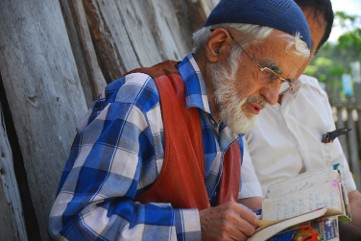
The date 1963 belongs to the copying of that manuscript. It is not a demonstrated date for the composition of the verse, nor the date of the expedition photograph. The report’s photograph accompanying the reading is reproduced here; the other images on the same book page concern different places.
Sources for the text and photographs are collected below. Community archive dates are posting dates, not verified capture dates. The expedition photograph accompanies the 2015 report of Niyaz’s reading, published in 2016.
- Mamia Paghava et al. — Shavsheti (2011)
- Roland Topchishvili & Inga Ghutidze — Historical place names in Russian documents (2019)
- Shushana Putkaradze — Chveneburebis Qartuli, Book I (1993)
- Teimuraz Khutsishvili et al. — Tao-Klarjeti 2015 expedition reports (2016)
- (Hakan) Gaffar YILMAZ / Temur KATAMADZE — Georgian villages and family lineages in Turkey, update 8 (2026)
- Şavşat community archive — Manatba / Yeşilce
Photo credits
- Manatba — Manatba. Archive contributor: Fuat Akdemir; posted 5 August 2004. Capture date not given.
- Another view in the Manatba collection — Another view in the Manatba collection. Contributor: Fuat Akdemir; posted 5 August 2004.
- An undated snowy view captioned Manatba — An undated snowy view captioned Manatba. Contributor: Fuat Akdemir; posted 5 August 2004.
- Niyaz Arslan / Jijanidze, pictured with his reading — Photograph accompanying Niyaz Arslan / Jijanidze’s reading in the Manatba–Machkhateti section of the 2015 expedition report. Khutsishvili et al., published 2016.
A living archive. An ongoing conversation.
Documenting Imerkhevi through language, places, songs and shared memories.
Created by Ömer Faruk Bülbül · Sources & image credits