Ube / Oba
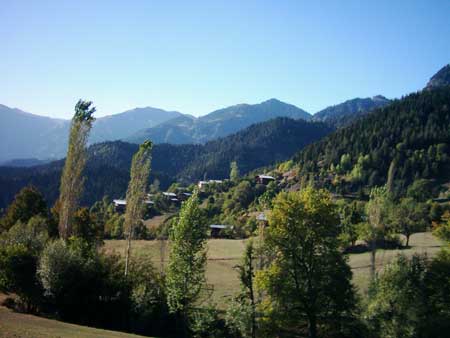
Ube (უბე), known today as Oba or Obaköy, is one of the villages of Imerkhevi in the Şavşat district of Artvin. Its story survives in place-names, family memories, old buildings and the Georgian voices recorded here.

A name shaped by the landscape
The Georgian word ube can describe a bay or sheltered recess. Reading the village name as a protected place in the landscape is a published interpretation, rather than proof of when the settlement began. The Turkish name Oba is reported to have been adopted in 1925. [7]
A village across changing borders
Ube’s history belongs to the wider story of Imerkhevi and Shavsheti. The region spent centuries under Ottoman administration, passed into Russian imperial rule after the war of 1877–1878, and experienced further upheaval during and after the First World War. The border arrangements of 1921 placed this part of Imerkhevi in Turkey. These are regional milestones; they should not be mistaken for a date of foundation for Ube itself. [1]
A dated glimpse of the population
The historical place-name study by Topchishvili and Ghutidze records 22 households and 157 residents in 1886, classified as Georgian in that register. It names Gorgadze and Chividze/Chivieti as village districts. These figures describe a particular historical record, not the present population or a complete account of identity. [2]
Marr’s journey and the church remains
During his 1904 journey, Niko Marr reached Ube by the mountain route from Diobani. His diary mentions Zed-Ube and describes ruined church masonry below the village: stones had been reused in a wall, making the original foundation difficult to distinguish. Continuing towards Daba, he also examined a church in the DevaZeebi/DevaZevi neighbourhood. The diary preserves a traveller’s observations at that time; it does not tell us what remains intact today. [3]
The local Khandzta: a name is not an identification
Khandzta or Khansta appears on Marr’s route to Ube. The editor of the 2015 Georgian edition reports revisiting the local site in 2005 and 2011 without locating the remains claimed by a guide, and argues against identifying it with the monastery of Grigol Khandzteli. A 2019 place-name inventory nevertheless mentions monastery ruins at Ube’s Khandzta. The sources therefore differ. This archive records the local name while leaving the site’s identification open. [3] [2]
Neighbourhoods, names and family connections
Shavsheti records Ube neighbourhood labels including Ortamehele, Ibisha Mahale, Gorgieti, Chivieti and Kortokhaze Mehele. Its family table places Turkish surnames alongside Georgian names and reported places of origin. Examples include Altun–Molashvili, Gül and Kayan–Chividze, and Dursun and Turan–Bolkvadze. The authors explicitly describe the material as incomplete and still being checked. These are documented leads for family history, not automatic proof that everyone sharing a surname has the same ancestry. [1, p. 96]
Small place-names make a larger map
A village is more than one name. The studies record Zedube, interpreted as “upper Ube”, and Zemobani, an upper neighbourhood. Tsetskhladze also records Tskaroti for springs, Akho among cultivated places, and Samghereli as a cultivated plot associated with Ube. Such names preserve ways of describing water, land use and position within the settlement. Their precise locations still need a village-level map and local confirmation. [1, p. 314] [4]
Wood, water and everyday ingenuity
One memorable detail in Shavsheti is the wooden water piping preserved by the Molidze family, then using the surname Altun. Hollowed logs, up to roughly two metres long and 20–25 centimetres across, were joined tightly enough to carry water to the home. Doğanay and Orhan’s study of traditional Şavşat houses also includes an Oba house plan as Figure 3. Together, these records make domestic life and practical craftsmanship part of Ube’s history. [1, p. 103] [6]
Georgian speech, stories and proverbs
Ube contributes examples to the linguistic sections of Shavsheti. One example uses tsotskhloba in the sense of living or residing, illustrating how familiar Georgian words can have locally characteristic uses. The folklore collection also credits Gulhan Bilir of Ube, aged 60 at the time, for proverbs recorded by Tina Shioshvili on 27 July 2005. These dated records give us individual voices, rather than a claim that every resident speaks or remembers the same way. [1, pp. 286, 507–508]
Ube in song and dance
The 2025 music-and-dance monograph discusses Ubis serze, a lyrical song about a girl from Daba marrying in Ube, with different interpretations reported by informants. It also documents a women’s circle dance, Tsadgomilay, recorded in Ube in 2022 at Ayten Dursun’s home. The dancers link little fingers and move to accordion accompaniment. The appendix identifies further Ube performances, including Dartulay. Lyrics, recordings and translations can later be connected to the songs collection without treating every performance as a song originating in Ube. [5]
Sources and reading notes
- Mamia Paghava et al., Shavsheti (2011), pp. 18–25, 37, 96, 103, 286, 314, 507–508.
- Roland Topchishvili & Inga Ghutidze, Historical Place Names of Shavsheti and Klarjeti (2019), p. 121.
- Niko Marr, Shavsheti and Klarjeti Travel Diaries, Georgian edition (2015), editor’s introduction pp. 15–16 and diary pp. 212–214.
- Nugzar Tsetskhladze, Shavsheti–Imerkhevi Toponymy (2000), PDF pp. 46, 57, 68; local-name catalogue. PDF and printed pagination differ.
- Giorgi Kraveishvili, Giorgi Alimbarashvili & Khatuna Damchidze, Musical and Choreographic Folklore of Georgians and Abkhazians in Turkey, vol. 1 (2025), pp. 163, 174, 178, 285–286.
- Hayati Doğanay & Fatih Orhan, Şavşat’ta Geleneksel Köy Meskenleri ve Başlıca Sorunları (2014), Figure 3, PDF p. 17.
- TAO-KLARCETİ: Ube, for the name interpretation and the reported 1925 renaming. Historical details below primarily follow the books above.
- Şavşat community photo archive: Ube–Oba. Original image metadata retains listed contributors and posting dates; these are not automatically capture dates.

A living archive. An ongoing conversation.
Documenting Imerkhevi through language, places, songs and shared memories.
Created by Ömer Faruk Bülbül · Sources & image credits