If you hear Georgian spoken in Imerkhevi, you may recognise much of it and still find yourself listening a little more closely. A familiar word has a different sound. A sentence takes an unexpected turn. A Turkish word appears inside otherwise Georgian speech. For some listeners, the strongest impression is that it sounds old.
But what do we call this speech? Imerkhevian Georgian? Shavshian? A southwestern Georgian dialect? These names all appear in the literature, and they do not always cover exactly the same thing. To understand the differences, we need to ask what area an author is describing, how much local material was available, and what they mean by a dialect.
The short answer is that Imerkhevian is a variety of Georgian, usually placed in its southern or southwestern dialectal area. In the classification presented by Mamia Paghava, Meri Tsintsadze and Maia Baramidze in 2022, Imerkhevian and Machakhelian are two subdialects of Shavshian, which belongs to the southern Georgian group alongside Taoan, Klarjian and Adjarian. That is a specific scholarly classification; it helps explain the speech without making every other use of the name “Imerkhevian” disappear.
Why are there so many names?
Part of the difficulty begins with geography. Imerkhevi is part of historical Shavsheti, but the valley’s name became especially important in linguistic writing because Georgian survived there and researchers recorded it there. A name drawn from one surviving area could consequently become a label for a much wider body of speech.
This is why an older reference to the “Imerkhevian dialect” may mean more than the Georgian of the Imerkhevi valley alone. Some descriptions use Imerkhevian or Klarjian in a broad sense for Georgian varieties in historical Shavsheti–Klarjeti. More recent field studies often separate local varieties more carefully. A difference in terminology can therefore reflect a difference in scale, rather than a disagreement about whether people are speaking Georgian.
There is also a smaller distinction worth keeping in mind: Imerkhevian is not Imeretian. The similar English names refer to different places and different Georgian dialects.
What Marr recorded
Niko Marr’s expedition to Shavsheti and Klarjeti in 1904 provided an important early body of local speech. His material appeared in 1911, with texts, linguistic observations and a glossary. The 2015 Georgian edition of his travel diaries makes these observations accessible together with a substantial modern introduction.
Marr used the designation Imerkhevian. Paghava’s introduction to the Georgian edition explains how this terminology became established for speech in Shavsheti and Klarjeti, while also questioning whether a name taken from Imerkhevi adequately represents the whole area. Marr’s work is therefore important both for the material it preserves and for the terminology later researchers inherited.
It would be misleading to turn his observations into the precise classification tree proposed a century later. Marr was describing the speech available to him and comparing particular features with other Georgian varieties. He frequently brought in Gurian, and sometimes Imeretian, parallels. The modern introduction points out that these were varieties familiar to him; his opportunities for comparison were not the same as those of later researchers working across the Chorokhi basin.
His notes also show why the speech attracted attention. In Zakieti, he heard a distinction between sounds represented by ჴ and ხ, and compared it with Old Georgian. He discussed older consonant sequences and forms, but also assimilation, sound loss and other changes. Already in this early account, Imerkhevian appears as a living variety with several historical layers.
That is the most useful way to read Marr here: as a foundational witness to the local speech and an influential source for the name “Imerkhevian,” rather than as the author of every classification subsequently published under that name.
Paghava’s southern Georgian group
The opening pages of A Shavshian Dialect of the Georgian Language set out a more differentiated picture. Paghava, Tsintsadze and Baramidze call the Georgian of the Chorokhi basin southern speech and distinguish four dialectal units within it: Taoan, Klarjian, Shavshian and Adjarian. Their discussion draws on renewed fieldwork after access to these regions became possible again in the late twentieth century.
Within Shavshian, they distinguish Imerkhevian and Machakhelian subdialects. In this model, Imerkhevian is the name of a more local variety, while Shavshian is the wider dialect to which it belongs. Machakhelian is its fellow subdialect within Shavshian.
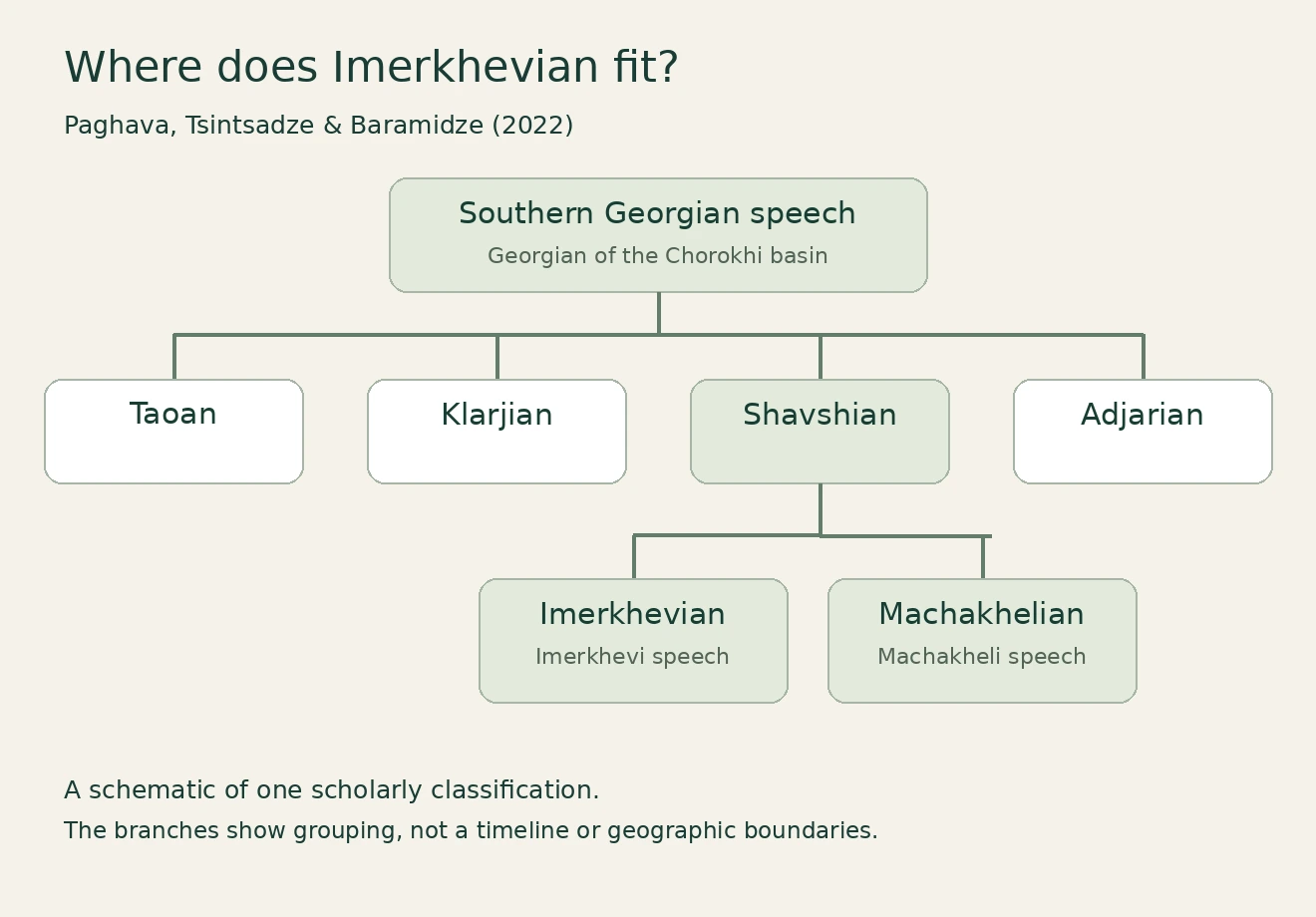
The choice of Shavshian is deliberate. The authors argue that, because Imerkhevi is part of Shavsheti, the larger historical regional name is more appropriate for the dialect as a whole. Their introduction also discusses differing historical descriptions of the region, including the position of Machakheli. Historical boundaries and linguistic groupings need to be explained; neither can simply be read off a present-day state map.
This does not mean that Imerkhevi and Machakheli sound identical, or that every village follows the same pattern. Calling two varieties subdialects places them within a shared framework while leaving room for differences in pronunciation, grammar and vocabulary.
Nor should this classification be silently extended to every Georgian-speaking community in Turkey. The authors distinguish the southern dialects from one another, and treat the speech of muhajir descendants as valuable evidence for the regional varieties from which those communities came. Migration does not, by itself, produce a single uniform “Turkish Georgian dialect.”
Southern or southwestern?
Both terms are used, but the lists attached to them may differ. The widely cited grouping summarised in Reyhan Lütfiye Okumuş’s 2019 thesis places Gurian, Adjarian and Imerkhevian together as southwestern dialects, following the classification of Gigineishvili, Topuria and Kavtaradze. Paghava and his co-authors discuss alternative terminology and prefer southern dialects for the Chorokhi-basin grouping they describe.
So “southwestern” and “southern” are not always interchangeable headings over an identical list. An article may use Imerkhevian as one southwestern dialect; another may use Shavshian as a southern dialect and Imerkhevian as one of its subdivisions. Before comparing their conclusions, we have to compare their definitions.
Other researchers also draw the internal boundaries differently. Shushana Putkaradze’s account of her own research, published by Batumi Shota Rustaveli State University, distinguishes Imerkhevian, Nigalian or Livanian, Machakhelian and Taoan as dialects within a Tao–Klarjetian grouping. Machakhelian is thus given a different rank from the one it has in the 2022 Shavshian monograph. This is an example of scholarly disagreement over grouping and rank, rather than a simple choice between a correct and an incorrect local name.
What about “Şavşat Georgian”?
In Turkish and English research, you may also meet the term Şavşat Georgian. Okumuş uses it in her study of aspect and verbal suffixes because her data comes primarily from speakers originating in Şavşat/Imerkhevi. She explains that the broader label Imerkhevian has sometimes been used for Georgian across Turkey, and chooses a narrower designation to avoid assuming that all those varieties have the same structure.
Her map also reminds us that the speech is not confined to the valley. It marks Artvin and communities in Bursa, Sakarya and Kocaeli connected with migration from the Şavşat area. This is a map of locations discussed in that study, not an exhaustive survey of Georgian speakers and not a map separating Imerkhevian from Machakhelian.
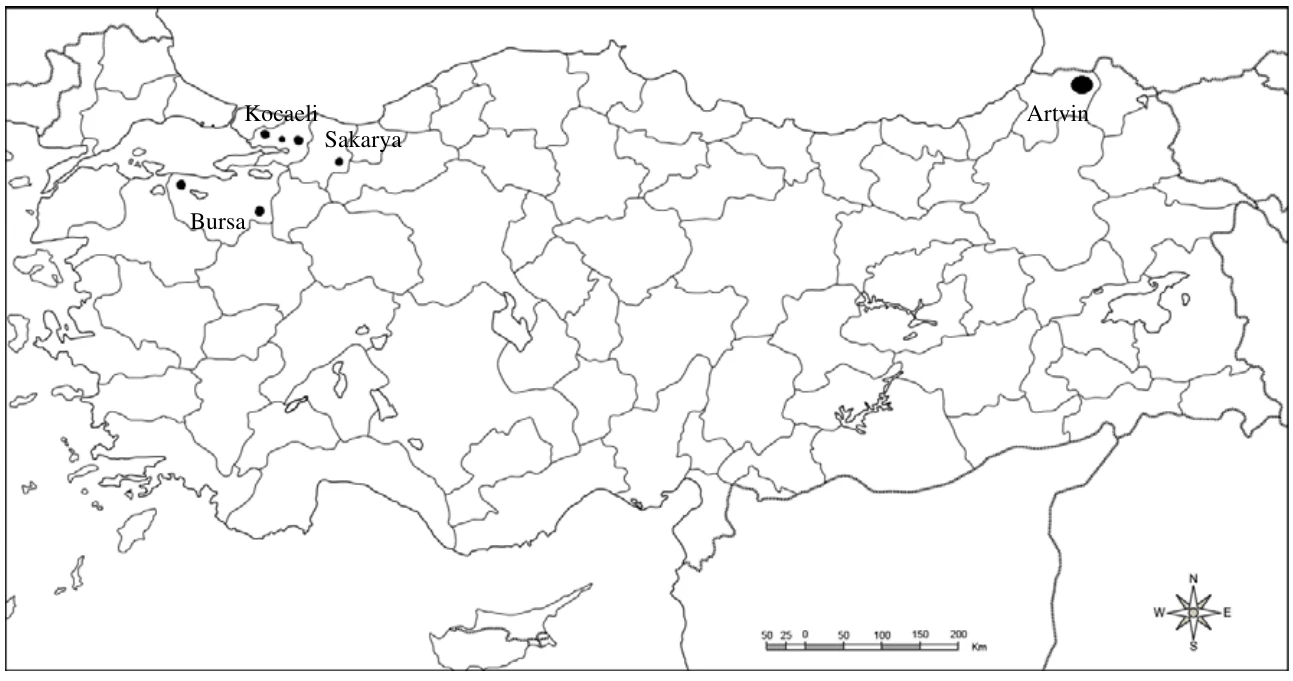
These names can be useful for different purposes. Imerkhevian identifies the valley and its speech; Şavşat Georgian can specify the origin of a study’s speakers; Shavshian places the local varieties within a wider historical and dialectological framework. The important thing is to say which meaning is intended.
Why does it sometimes sound old?
People sometimes describe Imerkhevian as old, antique or close to Old Georgian. Such impressions can express affection, recognition or surprise: a listener encounters a word or pronunciation absent from their everyday Georgian and associates it with an older period. But a listening impression is not quite the same thing as a linguistic demonstration.
An archaic feature is a particular sound, form, construction or meaning retained from an earlier stage. A dialect can preserve such features while changing in many other respects. We should therefore ask which features are old, where they occur, and what evidence connects them with earlier Georgian.
The 2022 monograph gives concrete examples. Its discussion of ჴ returns to Marr’s observations and reports the sound in later field material. At the same time, the authors note alternation between ჴ and ხ, rather than assuming that the older distinction functions unchanged everywhere. This makes the comparison with Old Georgian interesting precisely because the details matter.
Grammar offers another example. The book records the older ergative ending -მან in forms such as დათვმან (“the bear,” in the ergative) and დრომან (“time,” in the ergative), in material from Ustamisi. These are individual attested forms, not a claim that all speakers regularly use -მან wherever modern standard Georgian uses -მა.
The vocabulary and noun stems tell a similar story. The authors discuss ჯინჭველი, “ant,” as an archaic consonant-stem form, alongside a vowel-stem variant. Elsewhere, they compare particular verb formations with Old Georgian. The evidence for an older layer is therefore more specific than a general feeling that the accent sounds ancient.
Marr’s own notes are instructive on this point. He identified the sequence in memre, “afterwards,” as archaic, but also observed that it was common in other Georgian dialects. A survival can be historically important without being unique to Imerkhevi.
We can say, then, that Imerkhevian preserves features valuable for studying the history of Georgian. Calling the whole variety “Old Georgian,” however, would collapse the difference between an earlier historical stage and a present-day spoken dialect. Its speakers have continued to create sentences, adapt words and change their speech through generations.
Turkish words and Georgian structure
The Turkish element is another part of that history. The Shavshian monograph describes substantial lexical borrowing while emphasising the dialect’s Georgian structural basis. Its treatment of loanwords shows how borrowed material is adapted to Georgian pronunciation and grammar.
For instance, it records ქითაბი, “book,” from Turkish kitap, and ბაირამი, “holiday,” from bayram. The forms are discussed among borrowed nouns that take Georgian nominative marking. The words themselves tell us about contact; the way speakers use them also tells us about the grammatical system receiving them.
An old Georgian feature and a Turkish loan can therefore occur in the same speaker’s repertoire without contradiction. Neither observation alone classifies the dialect. A description needs to consider the sound system, inflection, sentence patterns and vocabulary together, as well as variation between communities.
A useful way to describe it
For this archive, “Imerkhevian Georgian” remains a useful and recognisable name for the speech of Imerkhevi and communities connected with it. When discussing dialect classification more precisely, it is worth adding that Paghava and his co-authors place Imerkhevian together with Machakhelian within Shavshian, in their southern Georgian group.
That wording leaves room for the history of the subject: Marr’s early recordings, the broader uses of Imerkhevian in dialectological literature, and the distinctions made possible by later fieldwork. It also leaves room for the speakers themselves. A classification helps us compare their speech; recordings and conversations show how much life there is inside the categories.
As fieldwork material is added to this archive, these questions will become easier to hear as well as read: which older forms remain in use, how villages differ, and how speakers move between Georgian and Turkish in everyday life.
Sources & image credits
Main linguistic source: Mamia Paghava, Meri Tsintsadze and Maia Baramidze, ქართული ენის შავშური დიალექტი (გამოკვლევა, მასალები, ლექსიკონი) / A Shavshian Dialect of the Georgian Language, Batumi, 2022. Especially pp. 4–6 (terminology and classification), 8–11 (sounds), 39–47 (loanword adaptation), 50 and 53–54 (noun stems, case and number), 76–83 (verbal morphology), and 633–634 (English summary). Project research copy. The classification diagram was prepared for this article from pp. 4–5; it is an editorial schematic, not a reproduced figure from the book.
Marr: Niko Marr, შავშეთსა და კლარჯეთში მოგზაურობის დღიურები [Travel Diaries in Shavsheti and Klarjeti], Georgian edition, Batumi, 2015, recording the 1904 expedition and based on the work published in 1911. See the modern introduction, especially pp. 25–36, for the discussion of terminology and Marr’s linguistic observations; and Marr’s notes on Imerkhevian speech, pp. 226–228. The introduction’s later classification is distinguished here from Marr’s own observations. Marr’s original 1911 linguistic notes are also discussed and cited by the 2022 monograph. Project research copy.
Şavşat Georgian and the map: Reyhan Lütfiye Okumuş, Aspect and Thematic Suffixes in Şavşat Georgian, MA thesis, Boğaziçi University, 2019, pp. 3–5. The map is a cropped screenshot of Figure 1, “The location of Şavşat Georgian,” printed p. 5 (PDF p. 16), preserving its place labels and scale. It illustrates the locations selected by that study, not dialect boundaries or current speaker numbers. The older southwestern grouping is reported through the thesis’s review of Gigineishvili, Topuria and Kavtaradze (1961), via Tuite (1989), rather than presented as a direct consultation of the 1961 volume. Project research copy.
Alternative grouping: Shushana Putkaradze’s first-person account of her dialectological research in “იუბილარ შუშანა ფუტკარაძის სამეცნიერო ქრონიკა,” published by Batumi Shota Rustaveli State University. Used for her distinction between Imerkhevian, Nigalian/Livanian, Machakhelian and Taoan within a Tao–Klarjetian grouping.
Reading note: English renderings of Georgian examples and explanations are supplied for this article. Spellings and ranks such as “dialect,” “subdialect,” “southern” and “southwestern” follow the author being discussed. Historical descriptions are not treated as a present-day census, and examples from the wider Shavshian material are not assumed to occur in every Imerkhevian village.