When did the people of Imerkhevi become Muslim, and how did that change take place? The surviving accounts do not give us a single date or a single answer. Instead, they preserve different pieces of a much longer history: rulers entering Ottoman service, a family story about violence at a mill, memories of Christian ancestors, and Muslim villagers continuing to visit the ruins of churches.
Some of these pieces are strikingly personal. Others come from administrative records or from scholars interpreting earlier writing. They do not all describe the same place, the same generation, or the same kind of religious change. Putting them together means listening closely to what each source actually says, without making any one account speak for the entire valley.
Imerkhevi was part of the wider historical region of Shavsheti. Older writers sometimes discuss the two together; at other times they distinguish the Georgian-speaking valley from surrounding districts. This article keeps that distinction visible. Evidence from Akhaldaba, Tbeti or the wider Şavşat district helps explain the regional setting, but it cannot automatically be treated as the history of every Imerkhevian village.
A note on quotations: the English passages below are translations made for this article from the Georgian and Turkish editions listed in the expandable source section. Marr’s words are accessed through the 2015 Georgian edition of his diary. Chichinadze’s passages are quoted as reproduced in the 2011 collective monograph შავშეთი (Shavsheti), rather than presented as quotations independently checked against his original editions. Ellipses indicate omissions.
What kind of evidence survives?
The sources were produced at very different distances from the events they discuss. Ottoman documents can bring us close to appointments, property transactions and the names used by officeholders. A nineteenth-century traveller could observe a mosque, a religious ceremony or an inhabited village directly. But when that traveller asked how people’s ancestors had converted, the answer usually came through recollection.
Giorgi Kazbegi travelled in the region in 1874. Niko Marr’s expedition took place in 1904. Zakaria Chichinadze collected accounts in the late nineteenth and early twentieth centuries. Shushana Putkaradze’s 1993 collection preserves much later speech, including material from families who had moved away from their ancestral villages. None should be treated as an eyewitness to all the conversions described. They could, however, witness the religious lives and memories of their own informants.
This matters because a remembered act of coercion, an official’s Muslim name, and a candle lit at a ruined church answer different questions. The first tells us what a family transmitted about its past; the second can document a public position within an Islamic state; the third tells us about continuing practice. They become more useful when their differences are retained.
Ottoman rule and the conversion of local rulers
The clearest early framework is the incorporation of the region into the Ottoman administrative system during the sixteenth century. The 2011 Shavsheti monograph brings together Ottoman archival references concerning local rulers and estates in Shavsheti–Imerkhevi. Its discussion includes property acquired for the foundation associated with Lala Mustafa Pasha’s mosque in Erzurum and rulers identified with Muslim names.
The authors interpret this as a transition in which members of the Georgian ruling elite acknowledged Islam while retaining property and social standing under Ottoman authority. That is a specific explanation of elite accommodation: political service, inherited office, land and religious affiliation became connected.
Muammer Demirel’s administrative history gives a related example from Şavşat. He describes the appointment of the existing local ruler after Ottoman conquest and writes:
Yusbet Bey became Muslim after a time, took the name Mehmed, and is recorded in 1563 as Mehmed Bey, sancakbeyi of Şavşat.
Muammer Demirel, administrative history of Artvin, 2025; translated from Turkish
This is a modern historian’s reconstruction, not a confession left by the ruler himself. Even the identification of particular early officeholders needs care: the 2011 monograph discusses overlapping names and offers identifications as arguments. The larger point is better supported than a perfectly tidy family genealogy. Local leadership was being drawn into Ottoman institutions, and religious change could accompany that process.
It would be a large leap to conclude that an entire valley changed faith when its ruler did. A household might have had quite different pressures, loyalties and resources from a bey. The administrative evidence gives us an early political setting, not a register of everybody’s conversion.
A family story from Machkhateti
One of the most direct accounts of coercion appears in Putkaradze’s Chveneburebis Kartuli. In the Machkhateti section, a speaker recalls what a grandfather used to say about an earlier family member:
We used to be Christians. My grandfather would say: they tied our ancestor to the mill’s chakhchakhi and forcibly made him Muslim.
Family recollection recorded in the Machkhateti section of Putkaradze, 1993
The Georgian passage reads:
„ზუელათ ქრისტიანები ვყოფილვართ. ჩემი დედეი იტყოდა: — წისქვილის ჩახჩახში დოუბმან ჩუენი ბებერი და ისე ზორ გუუმუსლიმანებიანო.“
The text immediately turns to an explanation of the chakhchakhi: a rattling wooden mechanism associated with the mill. That small exchange anchors the story in a recognisable part of everyday working life. The speaker does not simply say that the family’s religion changed; the remembered explanation is an act of force.
This passage deserves to be included in any discussion of Imerkhevian conversion. It also deserves a precise description. It is a family narrative recorded long after the alleged event. It supplies no date, names no perpetrator and does not establish how common such acts were. The speaker attributes the story to a grandfather, who was himself speaking about an earlier ancestor.
Attribution also requires restraint. The passage follows a separately credited text by Eub Saraçi, or Mighmadze, whose family connection is Machkhateti and whose residence is given as Bursa. The conversion fragment begins after a divider without a fresh speaker label. Its placement securely connects it with the Machkhateti materials; it is safer not to assign the fragment confidently to the preceding named narrator.
The absence of a contemporary corroborating document does not make the recollection unimportant. Its strongest evidential value is that a family connected with Imerkhevi remembered conversion through coercion and preserved that account across generations. Whether the episode can be reconstructed as an individual historical event remains a separate question.
Memories of Christian ancestors in Dasamobi
Marr encountered another sort of family memory in Dasamobi. His diary introduces a local resident in these terms:
Mahmud Ahmed-oğlu Jarbidze, a Muslim Georgian, who claims that his grandfather was a priest in the church.
Niko Marr, diary of the 1904 expedition; translated from the 2015 Georgian edition
Here the narrator is Marr: the sentence is his report of a claim, not a verbatim transcript of Jarbidze’s own speech. Its importance lies in the combination of a present Muslim identity with a remembered Christian clerical ancestor.
There is also a difficulty within the account. Marr goes on to say that the church had already been ruined for several generations. That makes it unwise to turn “grandfather” into an exact genealogical interval and calculate a conversion year. A term of ancestry, a local memory or the transmission of the report may be less precise than such a calculation would require.
The passage nevertheless shows that Christian ancestry could be spoken about within a Muslim household. Religious change did not necessarily remove the memory of the people who had served an earlier church. Nor does a family memory of a priest mean that the household remained secretly Christian in Marr’s time. Those are different propositions.
Akhaldaba and concealed Christian practice
A particularly detailed regional account concerns Akhaldaba, outside Imerkhevi proper. The 2011 Shavsheti monograph reproduces Chichinadze’s report that the inhabitants explained the survival of their Georgian language by their late conversion and by a period of concealed Christian practice afterward. The duration remembered in the account is “fifty years.”
The passage also describes social separation from surrounding villages:
They gave no woman to anyone in marriage, nor did they themselves take wives.
Chichinadze’s account of Akhaldaba, reproduced in Shavsheti, 2011
In context, this refers to marriage relations with neighbouring communities. The reported withdrawal is connected with the inhabitants’ religious history and with their explanation of why Georgian had survived locally.
This is evidence of a remembered distinction between outward religious conformity and practice within a community. It also suggests that conversion could affect kinship and relations between villages, rather than being only an individual declaration.
But the account should not be expanded beyond its setting. “Fifty years” is a duration supplied through recollection, without a securely established starting date in the passage. Akhaldaba’s experience cannot stand for every settlement of Shavsheti, still less every household of Imerkhevi. It is a valuable comparison precisely because it preserves a distinctive local explanation.
Religion, language and the explanations people gave
Several of Chichinadze’s informants explained religious and linguistic change together. Read in isolation, such passages might suggest a single explanation of Ottoman influence. Read alongside one another, they are more complicated: some emphasise orders and pressure, while others describe decisions made within the community.
An unnamed Shavsheti villager, as reproduced in the 2011 monograph, explained the adoption of Turkish by referring to both government and religious teachers:
They listened to the request of the government and the mullahs and hodjas, and began learning Turkish.
An account collected by Chichinadze, reproduced in Shavsheti, 2011
Another informant, identified as Gordadze from Tsikhistavi, gave an explanation that placed much more emphasis on the villagers’ own priorities:
After becoming Muslim, Georgian was no longer necessary for us. We began studying in the language of our faith and completely forgot Georgian.
Gordadze of Tsikhistavi, recorded by Chichinadze; reproduced in Shavsheti, 2011
We ourselves tried very hard to learn the language of our faith.
The same informant
These statements tell us how later speakers understood the relationship between religion, education and language. They do not prove that abandoning Georgian was a religious requirement, or that every community followed the same course. The description of Turkish as the “language of our faith” belongs to the informant’s social world. It should not be confused with Arabic’s place in Islamic scripture and liturgy.
In another passage, an informant attributed intermarriage and language change to a command from the sultan:
From now on you must marry your sons to Kurdish or Turkish women, so that the young people learn to speak Turkish.
A purported order recalled in an account collected by Chichinadze; reproduced in Shavsheti, 2011
That is not an Ottoman decree reproduced from an archive. It is what a later narrator said had been ordered. The distinction is essential. Before treating it as an identifiable state directive, we would need to find the document or other independent evidence. As it stands, it records an explanation of linguistic change that circulated locally.
The same collection therefore preserves explanations that pull in different directions: compulsion, religious identification, marriage, migration and adaptation. Repeating only the passages about force would flatten the material. Repeating only those about willingness would do the same.
Why Imerkhevi did not simply follow the same linguistic path
The continued use of Georgian in Imerkhevi is an important complication in any attempt to equate Islamisation with a uniform loss of language. Chichinadze’s Tsikhistavi informant contrasted the valley with more accessible parts of Shavsheti, attributing its linguistic survival to difficult terrain and less outside settlement:
That is why the Imerkhevians retained the Georgian language.
Gordadze’s explanation, recorded by Chichinadze; reproduced in Shavsheti, 2011
This is a local theory of language survival, not a demographic survey. Geography, roads, schooling, trade, migration and family transmission would all need investigation. Yet it makes clear that speakers themselves recognised different outcomes within the region. Muslim affiliation and Georgian speech could coexist.
Religious expression could also take place in Georgian. Tina Shioshvili discusses a Georgian vaizi, or religious sermon, drawing on Putkaradze’s published material. Addressing people who do not know Arabic or Turkish, its wording includes:
Now you have heard the sermon in Georgian.
From the Georgian vaizi discussed by Shioshvili, 2016, citing Putkaradze, 1993
This is a later expression of Muslim religious life, not evidence of when conversion occurred. Its relevance is different: it prevents us from treating Georgian language and Islamic devotion as necessarily opposed. The source collection preserves both language loss associated with religious change and religious teaching addressed to Georgian speakers.
What Kazbegi could observe in 1874
Kazbegi’s comparison of Shavsheti and Adjara offers another strand of evidence. He states that the people of Shavsheti had adopted Islam earlier than the Adjarians. He associates stronger Ottoman influence with the region’s connections to Oltisi, Erzurum and Akhaltsikhe.
The statement is useful as a nineteenth-century assessment of relative timing. It does not establish an exact date for Imerkhevi. Kazbegi’s general remarks also cover a wider area than the individual villages about which he supplies observations.
He records a widespread awareness of Christian ancestry:
Their ancestors’ religion was Christian.
Kazbegi’s statement about Shavsheti, in his account of the 1874 journey
His discussion of Okrobageti is more concrete. He reports that a church had remained in use until recent years through the efforts of two or three Gurian women married to Shavsheti beys. At a cemetery beside the church ruins, he writes:
On the stone slabs we saw candles which someone had lit for the repose of the souls of the dead.
Giorgi Kazbegi, account of the 1874 journey
The women’s identities, the Armenian presence in Okrobageti, and the uncertain identity of the people who lit the candles all matter. These observations should not be turned into proof that Muslim villagers everywhere secretly practised Christianity. What Kazbegi does give us is a religiously mixed regional setting in which Christian worship and remembrance had not vanished at one stroke.
His sympathies were plainly shaped by his attachment to Georgian Christian heritage. Marr’s writing, too, sometimes expresses grief at the Islamic use of former churches. Such reactions tell us something about the travellers. They should not be mistaken for the inner experience of the Muslim people they described.
Pilgrimage and the continued use of older sacred places
Marr’s descriptions of pilgrimage are among the richest records of religious life in Imerkhevi. In Tetraketi he listened to villagers whom he explicitly identified as Muslim, describing how they prepared candles and travelled to sacred places:
We will go to the ziaret; we will make wax, melt it, dip in a thread and take it out; we will take it with us.
Tetraketi villagers’ account recorded by Marr in 1904
The diary continues with visits to Forta, overnight stays, dreams, petitions for healing or children, candles placed on stone, and offerings made in response to dreams. Marr understood these journeys in relation to the earlier Christian religious landscape. The worshippers’ own description used ziaret, a term belonging to their present religious vocabulary.
It is possible for a practice to have an older history and still be understood by those performing it within their Muslim lives. Calling every such visit concealed Christianity would decide in advance what the evidence is supposed to demonstrate. The pilgrims’ stated identity and their inherited customs both need to remain in view.
Marr’s description also resists the idea of one uniform response from Muslim religious authorities:
The mullahs do not interfere here. Some of them look in the book—the Quran—and advise a visit to the ziaret accordingly.
Marr’s account of the Tetraketi pilgrimage traditions
Elsewhere, the 2011 monograph discusses reports of religious teachers opposing visits to certain shrines. These accounts need not describe identical places or circumstances. Together they point to negotiation over accepted practice rather than a simple, everywhere-consistent boundary between a community’s customs and its religious teachers.
Marr also heard Christian calendar terminology in ordinary speech. A Muslim informant from Zakiyeti told him:
At Tavkvetiloba, when the month of Marioba is ending, snow will come.
A Zakiyeti informant recorded by Marr in 1904
Tavkvetiloba refers to the Christian commemoration of the Beheading of John the Baptist; Marioba is associated with the August feast of Mary. Their continued use shows that names used to organise seasonal knowledge could outlast a change of religious affiliation. It does not, by itself, reveal the speaker’s beliefs about either feast.
The nineteenth-century register: a different kind of source
Hasan Hüseyin Alemdar’s transcription and study of the İmerhev population register no. 2771 provides a useful counterweight to travellers’ narratives. The register begins in 1835–1836 and includes subsequent additions through Hijri 1258. It records male inhabitants for administrative purposes, with names, ages, family relationships and other identifying information.
Alemdar’s analysis identifies imams and other religiously designated men in village entries. For example, his discussion of Surevan notes an imam alongside other offices and occupations. This is evidence of established Muslim institutions in the nineteenth-century countryside, independent of an informant’s explanation of how a remote ancestor changed religion.
But the register was not designed to preserve conversion narratives. A Muslim name cannot tell us whether its bearer’s ancestor adopted Islam freely, under threat, to secure an office, through marriage, or by some other route. Nor can a register of selected male inhabitants be read as a complete account of everyone living in the district. Its value lies in what it actually records.
What can be said—and what remains open
The evidence supports a history with several connected processes. In the sixteenth century, local rulers were adapting to Ottoman administration, and conversion could accompany the preservation of property and office. Later recollections preserve accounts of coercion, resistance and concealed practice. Travellers encountered Muslim communities that retained memories of Christian ancestors and continued using older sacred places and seasonal names.
These are not interchangeable stages on a timetable we can assign to every village. They are different forms of evidence, separated by place, social position and the circumstances in which they were recorded. The date when a bey adopted a Muslim name is not the date when every household changed faith. The date when a family story was written down is not the date of the event it describes.
There is also no contradiction in recognising remembered coercion while taking later Muslim religious life seriously on its own terms. An ancestor’s experience does not determine the beliefs of every descendant. The people who spoke to Marr were not merely evidence of a lost Christianity: they were also people describing their own prayers, journeys, teachers and understandings of the sacred.
A fuller history would need more local archival work, dated evidence for individual congregations and mosques, and further family testimony gathered with careful attention to who transmitted it and when. For now, the most responsible answer is that Imerkhevi’s Islamisation was neither a single documented event nor a process explained adequately by one motive. Its sources preserve political adaptation, memories of violence, changing education and kinship, and the persistence of inherited practices within Muslim communities. Their differences are part of the history.
Sources, quotations & image credits
All English quotations are editorial translations of the identified passages. Quotation marks distinguish translated source wording from the surrounding synthesis; they do not imply that the speaker’s words were captured in a sound recording. Some are reported speech, some are a traveller’s own prose, and Chichinadze is cited through a later work. Printed page numbers and PDF positions are distinguished below.
Shushana Putkaradze, Chveneburebis Kartuli, Book I (1993)
Printed p. 258 (PDF p. 289): Machkhateti conversion fragment and explanation of the mill mechanism. The speaker of this fragment is not separately labelled. The preceding text is credited to Eub Saraçi (Mighmadze), from Machkhateti and settled in Bursa. Printed p. 275 is also cited by Shioshvili for the Georgian vaizi.
Mamia Paghava and co-authors, Shavsheti (Tbilisi, 2011)
Printed p. 17 (PDF p. 18): Ottoman archival references and the authors’ discussion of elite conversion. Printed pp. 28–30 (PDF pp. 29–31): Akhaldaba; language, religious education, purported orders, marriage and Gordadze’s testimony. Printed pp. 34–35: travellers’ accounts, Christian ancestry and shrine traditions. Chichinadze quotations are accessed through this work: it cites his 1913 publication, pp. 285 and 293–294, and his 1915 publication, pp. 44–47. The original Chichinadze editions have not been independently collated for this article.
Muammer Demirel, administrative history of Artvin (2025)
Printed p. 67 (PDF p. 12): Şavşat’s local ruler, conversion, the name Mehmed and the 1563 appointment record. Quoted as a modern author’s reconstruction, not as a ruler’s own statement.
Giorgi Kazbegi, Three Months in Turkish Georgia, Georgian edition (1995); journey of 1874
Printed pp. 90–91 (PDF pp. 88–89): regional comparison with Adjara. Printed p. 94 (PDF p. 92), footnote: Christian ancestry, Gurian women at Okrobageti and candles observed in the cemetery. Population, place and practice must be interpreted in their nineteenth-century context.
Niko Marr, Shavsheti–Klarjeti Travel Diaries, Georgian edition (2015); expedition of 1904
Printed p. 157 (PDF p. 80): Mahmud Ahmed-oğlu Jarbidze’s reported clerical ancestry and Dasamobi church. Printed pp. 139–140 (PDF p. 71): Tbeti church and mosque use. Printed pp. 224–225 (PDF pp. 113–114): Tetraketi pilgrimage, candles, offerings, religious teachers and Zakiyeti’s calendar terminology. English translations here are made from the Georgian edition; they are not represented as an independently collated translation from Marr’s Russian original.
Tina Shioshvili, Shavshuri Folklori, Vol. I (Batumi, 2016)
Printed pp. 130–131 (PDF pp. 131–132): discussion of the Georgian vaizi, citing Putkaradze 1993, p. 275. Used to discuss Georgian-language Islamic teaching, not to date conversion.
Hasan Hüseyin Alemdar, Çıldır Eyaleti İmerhev Sancağı 2771 Numaralı Nüfus Defteri’nin Çevirisi ve Değerlendirmesi (MA thesis, title page 2020)
PDF pp. 18–21: register chronology and coverage; PDF p. 34: Surevan village analysis and the imam entry; PDF p. 172: conclusion and the Hijri 1251–1258 date range. The thesis’s abstract gives 2019, while the title page gives 2020.
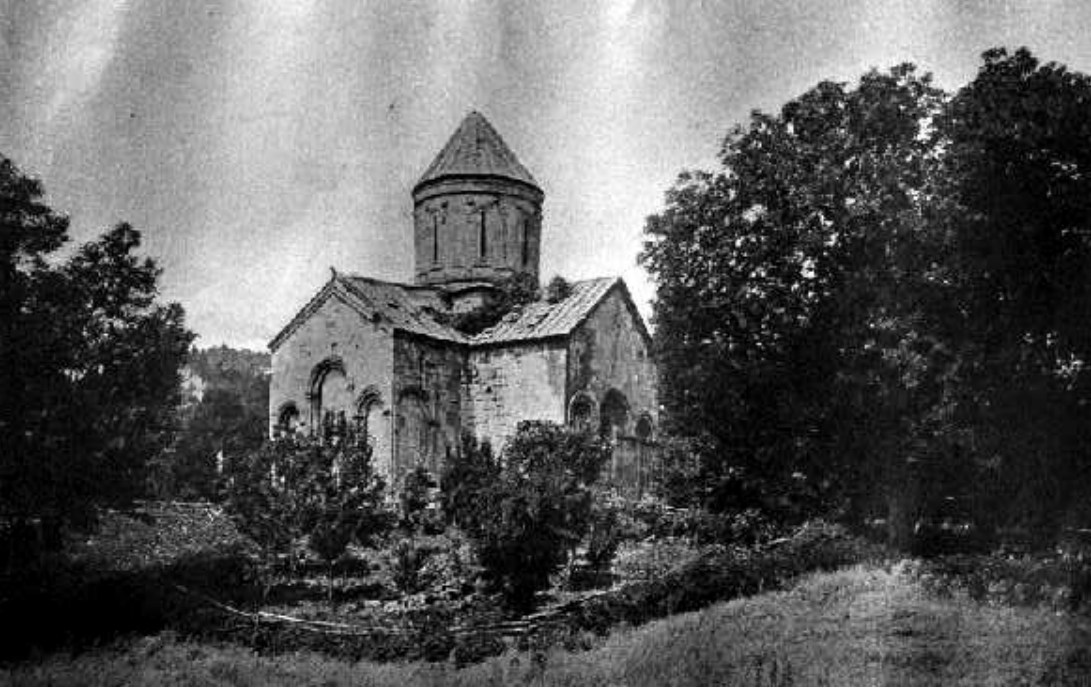
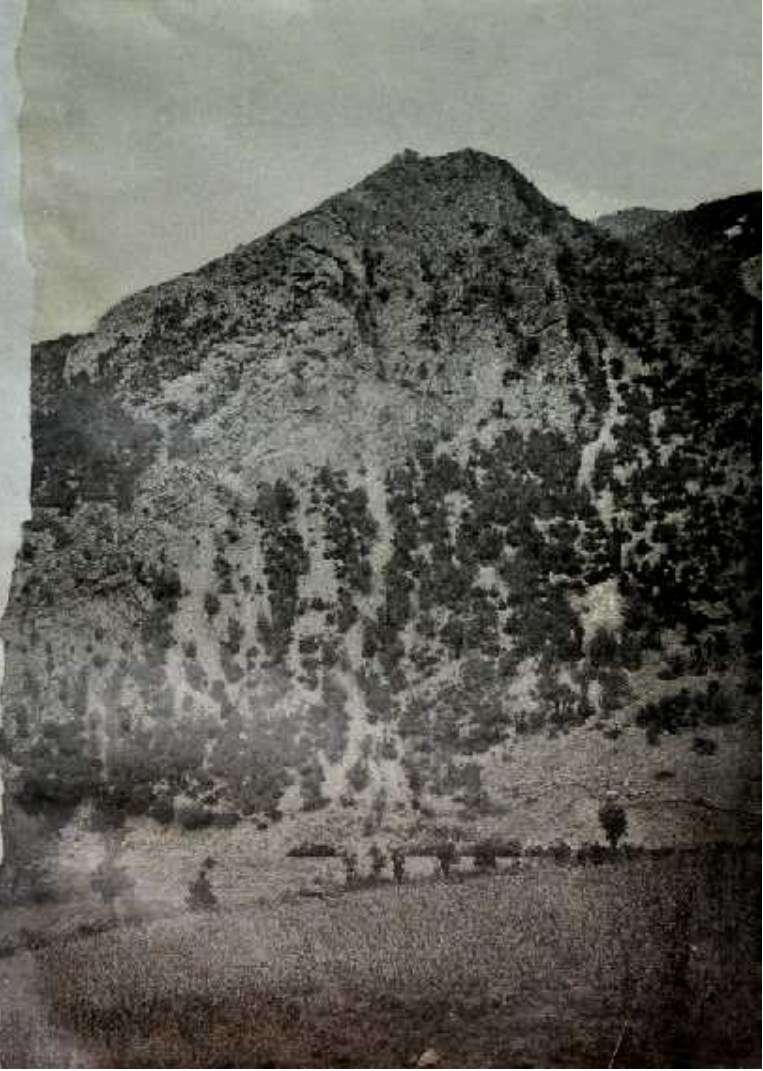
Images: Niko Marr expedition photographs reproduced from the 2015 Georgian diary edition. Tbeti: printed p. 428, fig. 2 (PDF p. 215), view from the southeast. Surevani church: printed p. 435, fig. 9 (PDF p. 219). Photographs have been isolated from the printed plates and, where necessary, rotated for reading. They illustrate buildings in the early twentieth century; neither depicts conversion or establishes its date.
Other works screened for context include the 2000 Shavsheti–Imerkhevi toponymy study, Paghava’s 2011 travel notes, the 2022 Shavshian dialect monograph, the 2016 expedition reports, and Kraveishvili’s 2018 dissertation. General regional statements or traditions from Tao, Lazeti, Adjara or Fereydan have not been substituted for evidence about Imerkhevi.