For some people, the idea of Armenians living in Imerkhevi might sound a little surprising. Yet the books describe Armenian and Georgian neighbours whose lives met in village homes, workshops, markets and places of worship. They visited one another, depended on one another’s work, and moved through the same valley. The history of Imerkhevi has room for these lives too.
Giorgi Kazbegi’s journey of 1874 and Niko Marr’s expedition of 1904 give us two views, thirty years apart. They were interested in different things, and neither gives a complete account of the Armenian population. But together their notes preserve a surprising amount: household numbers, church buildings, a conversation about lost trade, the names of local people, and even photographs of an ordinary working day.
Armenian communities in and around Imerkhevi
Phikiuri is the clearest Armenian settlement within Imerkhevi in these accounts. To understand its place, however, it helps to look along the roads leading out of the valley. Kazbegi encountered Armenian merchants and congregations elsewhere in Shavsheti as well. These were neighbouring communities, not additional villages that should all be counted as Imerkhevi.
At Tsikhisdziri, which he describes as Shavsheti’s administrative centre, Kazbegi found shops whose traders were Armenians from Artvin. At Okrobageti, he counted about seventy Armenian Apostolic households and described a settlement that had grown as families previously scattered around Shavsheti gathered there. It had become a trading place.
Satlel-Rabati presents another example. Kazbegi counted ten Armenian Apostolic and forty Armenian Catholic families in one part of the settlement, alongside a separate Georgian population in the other. He connects the merchants’ establishment there with the protection of Selim Beg Khimshiashvili and payments for the use of his estates. Trade, landholding and political protection were closely connected. Satleli’s importance, in his telling, owed much to those relationships.
This also reminds us that “Armenian” did not describe a single church affiliation. Kazbegi distinguishes Catholic Armenians in Phikiuri from Apostolic Armenians—whom the translation calls “Gregorian”—and records both congregations at Satlel-Rabati.
Kazbegi reached Phikiuri after travelling through the Imerkhevi valley. He identifies it as an Armenian Catholic village, also calling it Rabati. Official figures gave it eighteen households; he believed the actual number exceeded twenty-five. His account therefore offers both a useful snapshot and a reminder that even contemporary population figures did not always agree.
He also visited its church, which he describes as having been built on the ruins of an older Georgian church. The brief remark points to the layers of the local landscape: buildings could be rebuilt and used by new congregations while traces of earlier lives remained beneath them.
Kazbegi counted Armenian households more widely across Shavsheti, including Imerkhevi. His estimate of around 145 Armenian households belongs to that larger area, rather than to Imerkhevi alone. Keeping that distinction matters: the history of one river valley sits within a much broader network of settlements.
In Phikiuri itself, Kazbegi spent the night in a large wooden house among mulberry trees laden with fruit. The mulberries, he notes, were used to make rakhi. He could be dismissive about the scenery, but this glimpse of a house and its garden brings the village closer than his population figures do.
Safety and plans to leave
The mulberry gardens were only one part of Kazbegi’s visit. He also recorded a distressing conversation with a Phikiuri householder, who described demands for money and clothing, intrusions into homes, and an inability to resist those who mistreated them. Kazbegi presents the village’s Armenians as especially vulnerable in a countryside where protection was unreliable.
He writes that some Armenian Catholics were considering leaving for Batumi or Akhaltsikhe, and discussing an approach to the Russian vice-consul in Batumi. This is evidence of insecurity and plans being considered in 1874; it does not tell us that every family left, or establish the later fate of the community. His language can be sweeping and judgemental, but the anxieties he records deserve attention.
Crafts and trade
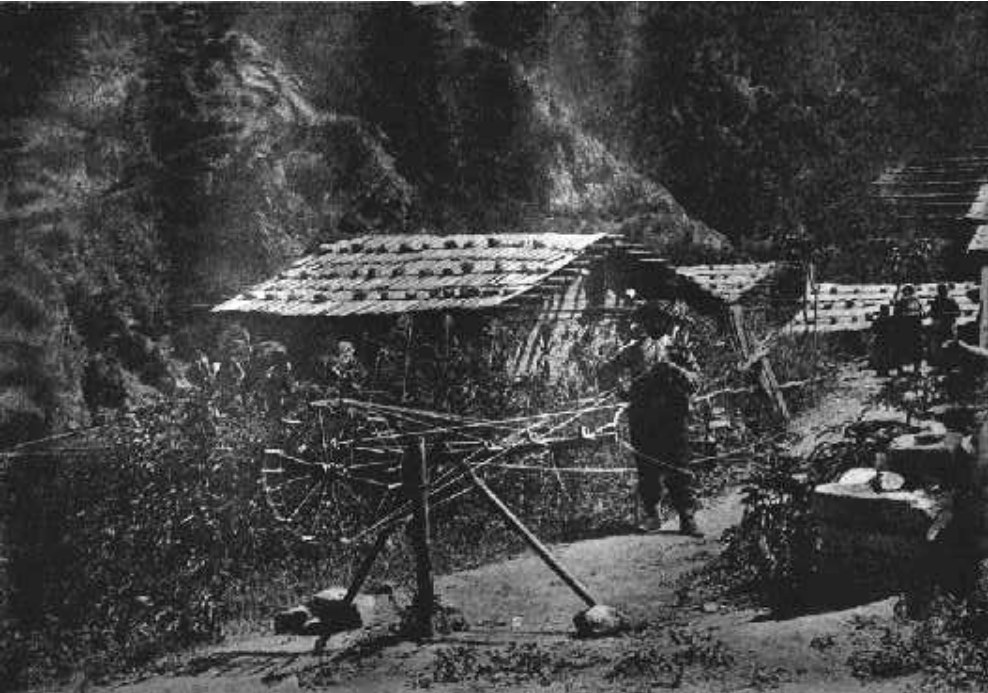
When Niko Marr travelled through the region in 1904, he found a community whose livelihoods depended heavily on trade and crafts. His diary describes tailoring, wool-working and shoemaking. He also records the equipment used to spin goat-hair thread and weave coarse cloth, small rugs and horse belts. These were practical skills woven into the economy of neighbouring villages.
Marr also records a memory of a larger village: the residents spoke of roughly seventy houses in the past, compared with twenty-four at the time of his visit. They said that some inhabitants had left and others had died. This is a recollection, not a census series; it should not be used to calculate a precise population decline between Kazbegi’s visit and Marr’s.
The residents told him that their ancestors had come from Ani. Marr recorded the tradition but questioned how readily such prestigious origins were claimed. We can preserve the story as something the community told about itself without treating the diary as proof of a particular migration.
Their explanation of growing poverty is particularly revealing. Earlier generations, they said, had lived from trade and bought good wheat in Artvin. Now surrounding villagers increasingly took their own produce to market, while poverty reduced the orders craftsmen received. Cultivation offered little escape because the Armenian households had too little land. A small community could become poorer even as its population declined.
Names and words
Armenian residents also appear as people helping Marr make sense of the landscape. Near Kvirala, he records a discussion with Nersensiants, an Armenian resident of Phikiuri, about an old building used for storage. They discussed whether it was a wine cellar or a winepress, moving between Armenian and Georgian terms: maran, hindzan and satsnakheli. The disagreement itself is valuable. It lets us hear neighbours explaining the same place in different ways.
Nearby, Marr heard Georgian Muslims call a spring chermuk, which he identified with Armenian jermuk. Such small observations show contact in everyday vocabulary, as well as in trade. A borrowed word does not establish anyone’s ancestry; it does show how difficult it is to divide the valley’s lived history into entirely separate compartments.
The fire of 1903
Marr was told that Phikiuri had burned eleven months before his visit. Residents said the fire destroyed old manuscripts in both Georgian and Armenian, including books whose writing they could no longer understand. His account records their testimony; he was not able to inspect the lost books.
The loss reached beyond houses and possessions. Manuscripts might have carried family memories, religious practices and traces of the languages used in the village. Their destruction helps explain why so much local history now has to be approached through scattered remarks, photographs and recollections.
Visits and places of worship
Marr’s photographs give us another kind of evidence. One is captioned as Imerkhevian Georgian Muslims visiting Phikiuri. In the diary, he says these visitors were calling at his host’s house after bathing at a nearby medicinal spring. Marr says he took the photograph secretly from his host’s window. That detail, too, belongs to the record.
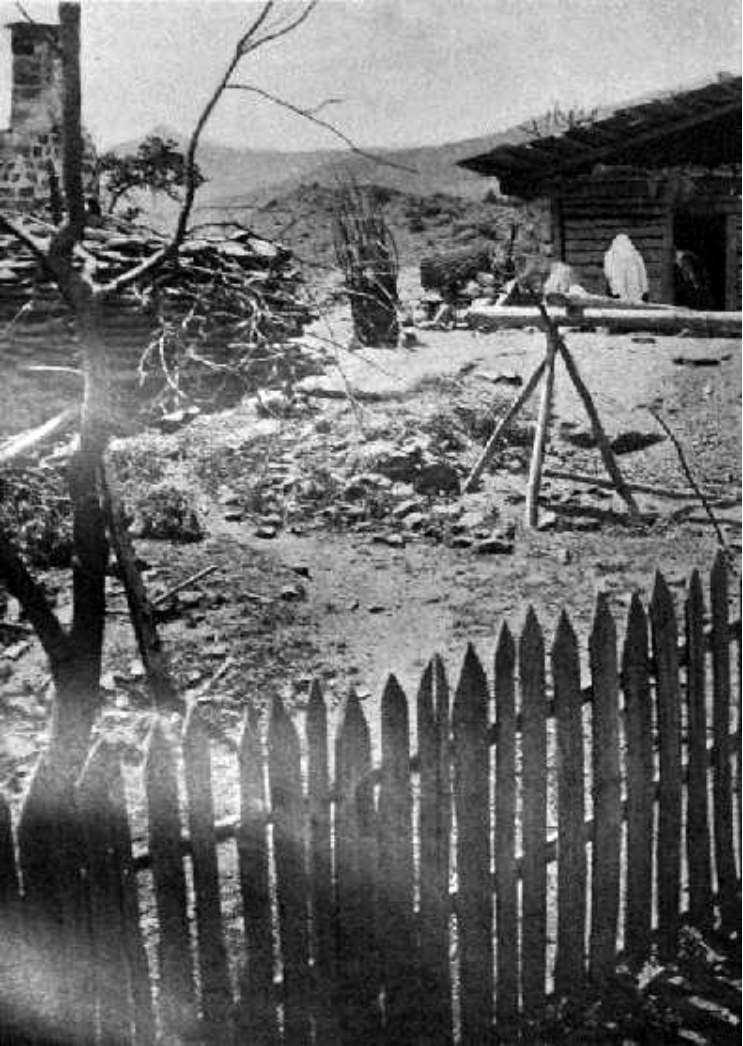
There were also places where communal boundaries overlapped. At the ruined church of Dasamobi, Marr recorded that Armenian Christians and Georgian Muslims alike respected the site as sacred and visited it to pray, sometimes at Easter. Difference did not prevent people from attaching meaning to the same place.
These encounters do not mean that relations were always easy. Kazbegi’s accounts of intimidation belong in the same history as Marr’s accounts of visits and shared devotion. What we see in these accounts is how people bought and sold, visited, worked for one another, exchanged words, and sometimes prayed at the same ruins.
There is still much to find out about the Armenian families of Imerkhevi: their own letters and memories, the routes by which they arrived or left, and the later history of their homes and churches. Kazbegi and Marr cannot answer all of that. What they do make clear is that Armenians were part of the valley’s social life, and that remembering Imerkhevi means remembering them as well.
Sources & further reading
This article draws chiefly on Kazbegi’s account, supplemented by Marr’s diary. Population figures refer to the travellers’ own periods and geographical scope. Oral traditions and residents’ testimony are identified as such; these accounts are not evidence of the settlement’s present-day population.
Giorgi Kazbegi, Three Months in Turkish Georgia, Georgian edition, 1995: pp. 78, 83–87, 90, 92–93. Journey of 1874.
Niko Marr, Shavsheti–Klarjeti Travel Diaries, Georgian edition, 2015: pp. 152, 157–158, 164–166, 169; photographs, pp. 439 and 441 (figs. 13 and 15). Diary of the 1904 expedition. The PDF displays two printed pages on each scan.