Settlement archive
Koklieti / Qoklieti
ქოქლიეთი · კოკლიეთი · Meydancık / Diyobani
Today’s status
Koklieti is recorded as a neighbourhood of Meydancık (Diyobani), not a separate modern administrative village. The 2015 expedition places its church site in the southern part of Meydancık; the 2026 lineage compilation retains Kokliyeti among the village’s neighbourhoods. A current neighbourhood-only population and year-round residence pattern are unverified.
Checked 17 October 2026
From mapped village to neighbourhood
The historical-name study records Qoklieti on the old five-verst map and identifies it as a neighbourhood of Diyobani. Its other list gives the related forms Qoklidze/Qoklieti. These changing labels are part of Imerkhevi’s settlement history: a named community could remain recognisable inside a larger administrative village. Diyobani’s 1886 figure of 72 households and 527 inhabitants belongs to the whole historical village, not to Koklieti alone. [1, pp. 14, 39]
The church site in 1904 and 2015
In 1904 Marr noticed old masonry on a small rise among maize fields, beside the road in Koklieti, which he called a Diyobani mehle. Residents called the place Saqdari, ‘church’. A large walnut tree stood in the middle. Marr considered the remains rectangular rather than cruciform, but could not establish the building’s full form. His account concerns a ruin already altered by that date. [2, p. 171]
A surviving fragment, carefully documented
The 2015 expedition found a surviving mortared wall core in a local resident’s yard in southern Meydancık and published the photograph reproduced below. Its record refers back to earlier researchers, including Marr. This comparison provides evidence for the persistence of the church site across two periods; it does not establish a construction date, dedication or complete architectural plan. The photograph records the condition in 2015, not a fresh survey of its condition today. [3, p. 68]
Names, families and spoken Georgian
The 2026 compilation lists Kokliyeti with Kolidzeler under Meydancık. Toponymic studies connect Qoklieti with the Qoqoladze family-name form; these source spellings should be retained rather than forced into a modern surname equivalence. Paghava’s field notes also preserve residents of Bzata naming Qoklieti, Ifkhreuli and Iveti as places where Georgian was spoken especially well. That is a recorded local assessment from the research period, not a current language census. [4–6]
Photographs & source documents
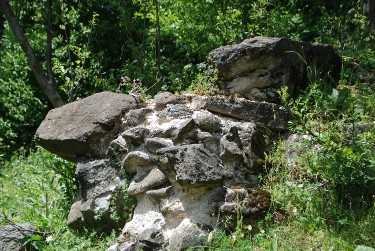
Surviving church wall fragment at Koklieti, photographed by the 2015 expedition
Tao-Klarjeti expedition report (2016), p. 68.

Kokliyeti in the Meydancık neighbourhood and lineage entry
Yılmaz (2026), p. 12.
Places connected in the sources
- Topchishvili & Ghutidze, historical place-name study (2019), pp. 14, 39.
- Niko Marr, 1904 travel diary; Georgian edition (2015), p. 171.
- Reports of the 2015 Research Expeditions to the Monuments of Tao-Klarjeti (Tbilisi, 2016), p. 68; photograph reproduced from the report.
- Yılmaz, Georgian Villages and Family Lineages in Turkey, eighth update (2026), p. 12.
- Tsetskhladze, Shavsheti–Imerkhevi Toponymy (2000), PDF p. 96; Paghava et al., Shavsheti (2011), pp. 302, 319.
- Mamia Paghava, Shavshuri Chanawerebi (2011), p. 182.
A living archive. An ongoing conversation.
Documenting Imerkhevi through language, places, songs and shared memories.
Created by Ömer Faruk Bülbül · Sources & image credits