Settlement archive
Kokbereti · კოკბერეთი
კოკბერეთი / კოკვერეთი · Chikhiskhevi / Yanıklı · Artvin Merkez
Today’s status
Kokbereti is documented as the lower quarter of Chikhiskhevi, whose modern village name is Yanıklı in Artvin’s central district. It is not separately verified as an independent administrative village. A Forestry Directorate report dated 12 June 2026 documents village residents and forestry work in Yanıklı, but supplies no Kokbereti-only household count. That village-wide evidence cannot establish whether every house in this quarter is occupied year-round. [P; S]
Checked 18 October 2026
A quarter of Chikhiskhevi
Kokbereti, also recorded as Kokvereti, appears in Paghava’s field diary as the lower quarter of Chikhiskhevi. The historical place-name study uses the form Kokibereti and includes it among the quarters of Chikhiskhevi, identified there with Yanıklı. These records describe a settlement within a larger village landscape, rather than establishing a separate modern municipality.
Language and family memory
During the visit described by Paghava, Georgian was spoken with difficulty in the lower quarter, and residents suggested going higher in the village to meet stronger speakers. This is a local observation from that visit, not a current language census. The diary records family or branch names including Qavejoghli, Khojioghli, Chikvia and Zuboghli. Accounts linking families with Rize, Adana or Crimea are presented as residents’ recollections of origin; they are not independently verified genealogies.
Reading the wider landscape
Paghava describes Chikhiskhevi as a green village landscape of orchards, maize fields and beans. That description belongs to the wider settlement. Keeping Kokbereti’s own name alongside neighbouring quarters helps preserve the small-scale geography that disappears when every locality is reduced to a single village name.
The lower quarter within a larger community
Paghava’s account follows a road uphill into Chikhiskhevi and first reaches Kokbereti. He describes the larger village as green and fruitful, with pears, apples, grapes, walnuts, chestnuts, maize and beans. The passage then moves between neighbourhoods, so its agricultural description should be read at the wider village scale.
The household names below are more precisely located: Paghava explicitly introduces them as families living in Kokbereti. Their remembered origins show the diversity of stories preserved by local speakers. The excerpt reproduces the relevant part of the printed source; a photograph of the Khozabiri remains is supplied separately as wider Yanıklı context, not as a monument in Kokbereti. [P, pp. 157–158]
Families and recorded surnames
Paghava records the following household names specifically in Kokbereti. The second column gives reported origins or a nickname explanation, not modern legal surnames; no secure Turkish surname pairings were supplied for these four entries. [P, p. 158]
| Recorded household name | Recorded recollection |
|---|---|
| Qavejoghli · ყავეჯოღლები | Reported as Laz, from Rize |
| Khojioghli · ხოჯიოღლები | Reported as having come from Adana |
| Chikvia · ჭიკვიები | A nickname explained through the small wren |
| Zuboghli · ზუბოღლები | Reported as having come from Crimea |
Photographs and source documents

Source document: Kokbereti family names, Paghava (2011), p. 158. This is a printed excerpt, not a village photograph.
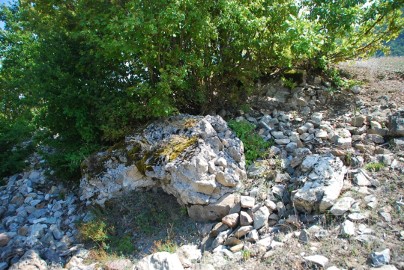
Wider Yanıklı context: Khozabiri church remains, a different quarter. This is not a photograph of Kokbereti. 2015 expedition report (2016), p. 134.
A living archive. An ongoing conversation.
Documenting Imerkhevi through language, places, songs and shared memories.
Created by Ömer Faruk Bülbül · Sources & image credits