Settlement archive
Sinkoti / Küplüce
სინკოთი / სინგოთი · Küplüce · Şavşat
Today’s status
This page concerns historical Sinkoti/Singoti, identified as Küplüce in Şavşat by the 2015 expedition and the 2019 place-name study. It is distinct from Sira-Sinkoti/Çayağzı and from the Klarjeti settlement called Sinkoti/Sümbüllü. It is included as a neighbouring historical settlement, rather than counted as a newly identified village of the Imerkhevi core. No current population total is supplied.
Checked 17 October 2026
Three namesakes kept separate
The 2015 inventory lists Singoti/Küplüce and Sinkoti/Sümbüllü in separate rows. The 2019 study also distinguishes Sin(g)kotia/Küplüce from Sira-Sinkoti/Çayağzı. Marr’s 1904 route crossed from the Chihori valley towards Sinkoti, then continued through Sira-Sinkoti and Mukhobani on the way to Khozabiri. Combining these places would obscure the traveller’s route and assign monuments to the wrong community. [1, p. 189; 2, pp. 9, 64; 3, pp. 234–235, 241]
The church documented in 2015
The expedition describes a large church north of the village, elongated east–west, with an inscribed-cross plan and galleries on three sides. The dome and upper wall sections had collapsed; side rooms and traces of plaster and faint red paint remained. Vegetation and fallen masonry made photography inside difficult. The report cites a ninth-century dating proposed by G. and N. Bagrationi and an attribution to St George reported by Bakradze; these are cited scholarly views, not a new dating made for this page. [1, pp. 34–35]
Towers and the changing language landscape
North of the village the researchers recorded a rock-built watchtower wall, approximately 6.5 by 2 metres in plan and 8 metres high. Marr had already mentioned a lookout tower in the area. Later fieldworkers describe Sinkoti as Turkish-speaking, in contrast to nearby Georgian-speaking Nioleti. These dated observations reveal a cultural boundary without fixing the language abilities of every resident today. The photographs show the 2015 survey condition; they do not certify current stability or visitor access. [1, p. 35; 4, p. 168]
Photographs & source documents
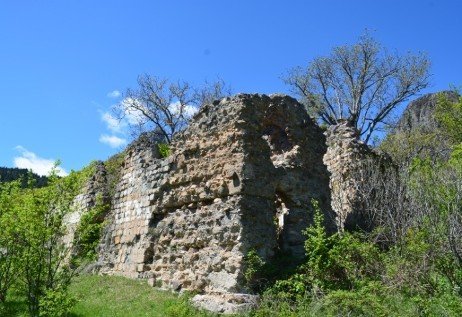
Sinkoti/Küplüce church ruins, 2015 documentation.
2015 expedition report (2016), p. 34.
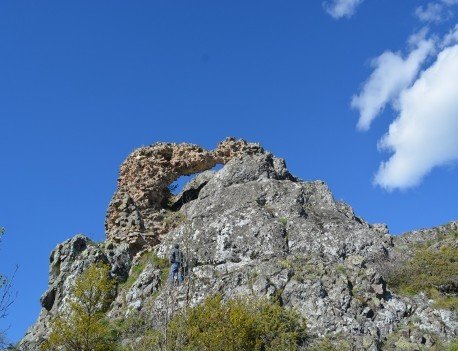
The rock-built tower north of Sinkoti, documented in 2015.
2015 expedition report (2016), p. 35.
- Khutsishvili et al., Reports of the 2015 Research Expeditions to Tao-Klarjeti (2016) — 34–35, 189.
- Topchishvili & Ghutidze, Shavsheti–Klarjeti historical place names (2019) — 9, 64.
- Niko Marr, 1904 Travel Diaries; Georgian edition (2015) — 234–236, 239–241.
- M. Paghava, Shavshuri Chanawerebi (2011) — 168.
A living archive. An ongoing conversation.
Documenting Imerkhevi through language, places, songs and shared memories.
Created by Ömer Faruk Bülbül · Sources & image credits